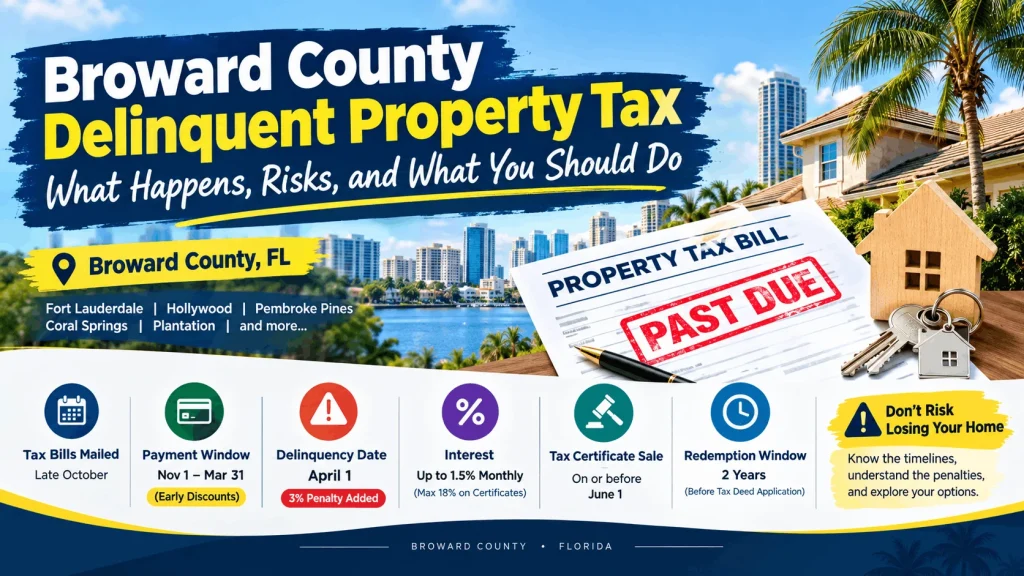
If you believe you paid too much property tax, paid taxes on the wrong property, or paid a tax that was not actually due, you may be able to request a property tax refund in Broward County, Florida. Florida law provides several circumstances in which property tax payments can be refunded, but the process depends on why the refund is being requested.
In Broward County, the Broward County Tax Collector handles the tax-refund process for property tax payments, while the Broward County Property Appraiser may become involved when a correction to the property tax roll is required. Florida Statutes also establish specific rules concerning erroneous payments, overpayments, deadlines, supporting documentation, and approval of certain refund claims.
A property tax refund is not necessarily the same as receiving a lower property tax bill. If your property’s assessed value is incorrect, you may need to address the assessment or exemption issue first. If you simply paid the wrong property account, however, a different refund procedure may apply.
This guide explains how to get a property tax refund in Broward County Florida, who may qualify, what forms and documents you may need, how long you have to file, and what to do if your refund request is denied.
What Is a Broward County Property Tax Refund?
A property tax refund generally means returning money that was paid toward property taxes when the taxpayer was entitled to have some or all of that payment returned.
Florida law identifies several circumstances that can lead to a property tax refund. These include certain overpayments, payments made when no tax was due, court-determined tax liabilities, erroneous payments made toward another property, and certain tax certificate situations.
However, the reason for the refund matters.
For example, these situations can be different:
- You accidentally paid the taxes for another property.
- You paid more than the amount actually due.
- Your tax bill contained an error.
- A property tax assessment was corrected.
- A court determined that you were not liable for a tax.
- A tax certificate was later corrected, amended, or determined to be void.
- You paid property taxes that were not actually owed.
The Broward County Tax Collector specifically provides an Application for Refund of Ad Valorem Taxes, Form DR-462, for qualifying refund claims.
Who Handles Property Tax Refunds in Broward County?
The Broward County Tax Collector is the primary office to contact about property tax refunds.
The Tax Collector collects property taxes and provides forms and instructions for refund claims. If the refund requires a correction to the tax roll, the Property Appraiser may also need to review and correct the record before the refund can be completed. Florida law specifically provides a process for coordinating the Tax Collector and Property Appraiser when a roll correction is necessary.
If you are unsure whether your situation qualifies for a refund, it is generally better to contact the Tax Collector before submitting incomplete paperwork.
Broward County’s Tax Collector lists its tax-services contact information as 954-357-4829 and revenue@browardtax.org.
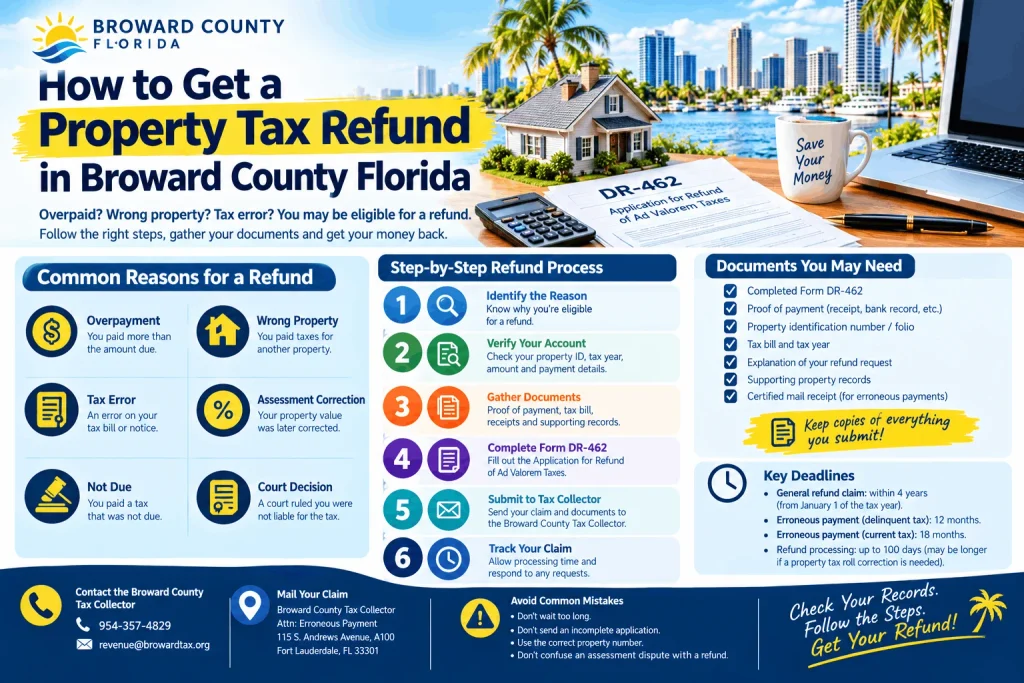
Common Reasons You May Qualify for a Property Tax Refund
1. You Overpaid Your Property Taxes
One common reason for a refund is an overpayment.
Florida Statute 197.182 provides for refunds in certain situations where an overpayment has been made. The law also provides that overpayments of more than $10 resulting from taxpayer error, when identified within the applicable four-year period, are automatically refunded under the statute. Overpayments of $10 or less may be retained unless the taxpayer submits a written refund claim.
This means you should not assume that every small overpayment will automatically result in a check.
If you believe you are owed a refund, verify the payment history and the amount recorded by the Broward County Tax Collector.
2. You Paid the Wrong Property Tax Account
Another important situation occurs when you accidentally pay property taxes for the wrong property.
For example, you may have entered the wrong tax account number while making an online payment. Broward County calls this an erroneous tax payment.
The Tax Collector advises taxpayers who made an erroneous online payment to notify the office immediately. Online payments may only be cancellable for a limited period, so acting quickly can make a significant difference.
If the payment cannot be cancelled, Broward County’s procedure may require you to request reimbursement from the owner of the property that benefited from your payment.
3. You Paid a Tax That Was Not Due
Florida law also identifies payments made when no tax was due as a circumstance in which a refund may be available.
The specific facts of the payment matter, so taxpayers should keep their tax bill, payment confirmation, and property records when requesting a refund.
4. Your Tax Bill Contained an Error
If you paid taxes because of an error in the tax notice sent to you, Florida law provides a specific refund process.
In this situation, the refund can be made directly by the Tax Collector without requiring approval from the Florida Department of Revenue. The taxpayer may also request that the amount paid in error be applied toward taxes for which the taxpayer is liable.
5. A Court Determines That You Were Not Liable
A refund may also arise from a bona fide dispute concerning tax liability when the taxpayer paid the amount claimed to be due and a court later determines that the taxpayer was not liable for all or part of the payment.
This type of situation can involve more complicated legal circumstances, so property owners should keep all court documents and tax-payment records.
How to Get a Property Tax Refund in Broward County Florida
The exact procedure depends on the reason for the refund, but the following process is a useful starting point.
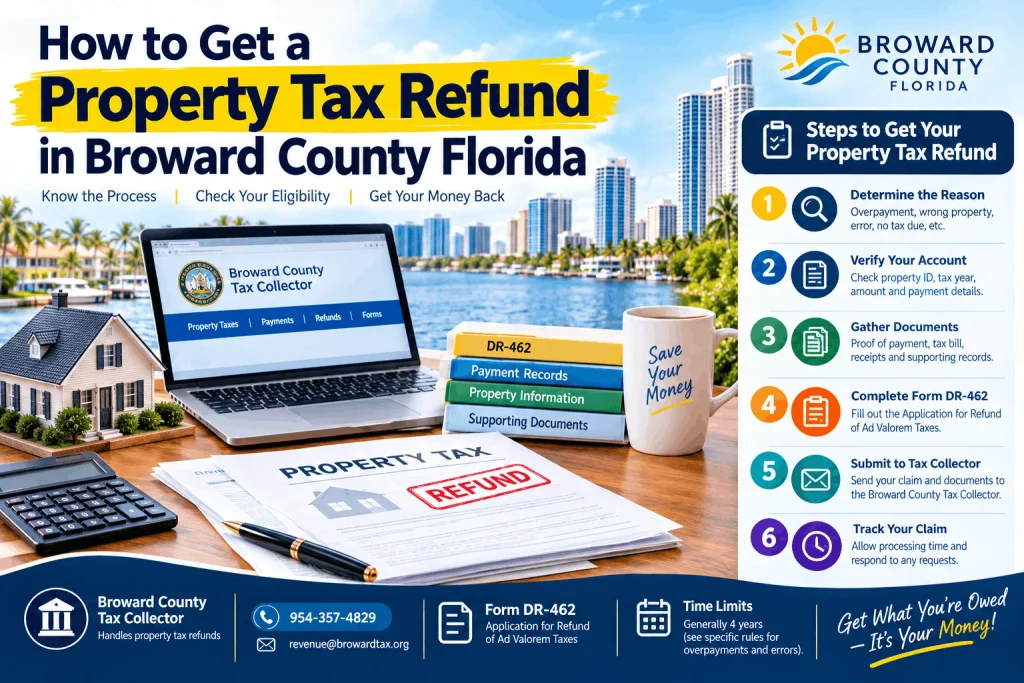
Step 1: Determine Why You Are Requesting the Refund
Before completing a form, identify exactly why you believe you are entitled to money back.
Ask yourself:
- Did I pay the wrong property?
- Did I pay more than required?
- Was there an error on the tax notice?
- Was the property tax assessment later corrected?
- Was the tax not actually due?
- Was the payment connected to a tax certificate?
- Did a court determine that the tax was not owed?
The reason should be clearly explained in your refund application.
Step 2: Verify Your Property Tax Account
Collect the information associated with the property.
Useful information may include:
- Property address
- Property identification number
- Folio number
- Tax account number
- Tax year
- Owner name
- Amount paid
- Date of payment
- Payment confirmation number
- Tax bill
Checking these details first can help prevent another error in the refund application.
Step 3: Gather Proof of Payment
Proof of payment is one of the most important documents in a refund request.
Depending on your circumstances, this may include:
- Paid property tax receipt
- Online payment confirmation
- Cancelled check
- Bank record
- Money-order receipt
- Wire-transfer confirmation
- Tax bill
- Payment transaction information
The current Broward County DR-462 instructions identify paid tax receipts and supporting documentation as part of the refund process.
Step 4: Complete Form DR-462
The official Application for Refund of Ad Valorem Taxes, Form DR-462, is available through the Broward County Tax Collector.
The form asks for information such as the applicant’s name, county, refund amount, tax year, mailing address, and the reason for the refund. Supporting documents should be attached to explain and support the claim.
Make sure the information on the form matches the county’s tax records.
An incomplete application can delay the process or result in the application being returned.
Step 5: Submit the Required Supporting Documents
Do not submit the DR-462 by itself if additional documentation is required for your particular claim.
For example, an erroneous-payment claim can require evidence showing:
- The payment was made by you.
- The payment was applied to the wrong property.
- The amount paid.
- Your attempt to obtain reimbursement from the property owner when required.
- Certified-mail documentation.
- Proof that the property owner did not reimburse you within the applicable period.
Broward County specifically warns that incomplete erroneous-payment claims may be returned.
Step 6: Send the Claim to the Broward County Tax Collector
Broward County’s current instructions direct refund applications and supporting documents to the Tax Collector.
For erroneous-payment claims, the county lists:
Broward County Tax Collector
Attn: Erroneous Payment
115 S. Andrews Avenue, A100
Fort Lauderdale, FL 33301
The county’s current instructions also state that original documentation should be submitted as required and that claims should not be sent by fax.
Always check the current Broward County instructions before mailing documents because procedures and contact information can change.
Special Process for Paying the Wrong Property’s Taxes
If you accidentally paid taxes for another property, there are additional steps to understand.
Broward County explains that an erroneous payment occurs when you pay taxes for the wrong property account. If the erroneous payment was made online, the Tax Collector advises contacting the office immediately because the payment may only be cancellable for a limited time.
If the payment cannot be cancelled, you may need to make a written demand for reimbursement to the owner of the property that benefited from the payment.
Under the procedure described by Broward County and Florida law, the demand must be sent by certified mail, return receipt requested, and the property owner generally has 45 days to reimburse the erroneous payment.
For an erroneous payment involving a delinquent tax, Florida law provides a 12-month period from the erroneous payment to make the required demand, subject to the other statutory conditions. For a tax that had not yet become delinquent, the applicable period is generally 18 months. The property also must not have been transferred to a third party for consideration before the required demand and refund process is completed.
Broward County’s published erroneous-payment instructions similarly identify 12 months for delinquent tax payments and 18 months for current tax payments.
Because these deadlines can affect your legal rights, do not wait until the deadline is close.
What Documents Do You Need for a Property Tax Refund?
The documents required depend on the type of refund.
A basic refund application may require:
- Completed Form DR-462
- Proof of payment
- Property identification number
- Tax year
- Tax bill or receipt
- Explanation of the refund request
- Supporting property records
- Correction documentation, when applicable
For an erroneous payment, additional documentation may be required.
Broward County’s instructions specifically mention items such as the written reimbursement request sent to the property owner, certified-mail receipt, proof of payment, and completed DR-462.
The current DR-462 instructions also state that supporting documentation should accompany the application.
Keeping copies of everything you submit is a good practice.
How Long Does a Broward County Property Tax Refund Take?
A refund is not necessarily immediate.
Florida Statute 197.182 establishes processing time requirements for certain refund claims. When a refund is approved and funds are available, the statute generally provides for payment within 100 days after the claim is made, although the period can be extended for stated good cause.
If a correction to the property tax roll is necessary, the process can involve the Property Appraiser.
Under the statute, the Tax Collector can notify the Property Appraiser of the refund application, and the Property Appraiser has a specified period to determine whether the roll can be corrected. Certain claims may then require review by the Florida Department of Revenue.
For that reason, taxpayers should not assume that submitting Form DR-462 automatically means a refund check will arrive within a few days.
What Happens If the Refund Requires a Property Tax Roll Correction?
Some refund situations cannot be resolved simply by checking the payment record.
For example, if the property’s assessed information needs to be corrected before the county can determine the appropriate refund, the Property Appraiser may need to correct the tax roll.
Florida law provides a process under which the Tax Collector sends the application to the Property Appraiser when a correction is required. The Property Appraiser then reviews whether the correction is legally permissible.
This is one reason it is important to distinguish between:
“I paid too much”
and
“My property was incorrectly assessed.”
The second situation may require property-record or assessment corrections before the refund can be processed.
How Long Do You Have to Claim a Property Tax Refund?
Florida law establishes a general limitation period for refund claims.
Under Florida Statute 197.182, a refund claim generally must be made within four years after January 1 of the tax year for which the taxes were paid, subject to the specific rules and exceptions in the statute.
However, erroneous-payment claims have additional deadlines.
For example:
- Certain delinquent-tax erroneous payments have a 12-month deadline.
- Certain current-tax erroneous payments have an 18-month deadline.
- The required reimbursement demand must be made within the applicable period.
- The property generally cannot have been transferred to a third party for consideration before the required process is completed.
Therefore, do not rely only on the general four-year limitation if your situation involves paying taxes for the wrong property.
Can You Get a Refund If Your Property Value Was Reduced?
A change in property value does not automatically mean that you will receive a property tax refund.
If you believe your property’s assessed value is incorrect, the issue may need to be addressed through the property assessment process. A later correction to the tax roll can, in certain circumstances, result in a refund.
The Florida refund statute specifically addresses refunds connected with changes and corrections to tax records.
If you believe the assessed value, exemption, or other property information is wrong, review the property record and contact the appropriate Broward County office rather than assuming that filing a standard refund request will automatically correct the assessment.
Can You Get a Refund for an Incorrect Homestead Exemption?
Homestead exemptions can affect the taxable value of a property, but an exemption issue and a payment refund are not always handled through the same process.
If you believe your homestead exemption was incorrectly applied, removed, or denied, you may need to address the underlying property-tax record with the Broward County Property Appraiser.
If correcting that record results in taxes being overpaid, a refund may potentially follow depending on the circumstances and applicable law.
Keep documentation relating to your property, exemption status, tax bills, and payments when investigating the issue.
What If Your Refund Application Is Denied?
A denied refund does not necessarily mean you have no further options.
Florida Statute 197.182 provides a procedure for refund denials. The statute states that the Tax Collector must issue the denial in writing after receiving the Department of Revenue’s written denial where applicable. It also provides a 60-day period for certain actions contesting a denial, subject to the requirements of the statute.
Because a refund dispute can involve legal deadlines, carefully read the denial notice.
If a significant amount of money is involved, consider obtaining advice from a qualified Florida property-tax attorney or other appropriate professional.
Common Mistakes to Avoid
Mistake 1: Waiting Too Long
Refund claims have deadlines. Erroneous payments can have shorter deadlines than the general refund limitation period.
Mistake 2: Sending an Incomplete Application
The Tax Collector requires supporting documentation for refund claims. Missing documents can delay processing or cause the application to be returned.
Mistake 3: Using the Wrong Property Number
Always verify the parcel, folio, or tax-account information before submitting your claim.
Mistake 4: Assuming Every Overpayment Is Automatically Refunded
Florida law contains specific rules for different types and amounts of overpayments. Do not assume that every payment discrepancy produces an automatic refund.
Mistake 5: Confusing an Assessment Dispute With a Refund
If the underlying problem is an incorrect assessment or exemption, you may need to correct the property record before addressing the resulting tax overpayment.
Mistake 6: Failing to Keep Copies
Keep copies of your DR-462, tax bills, payment receipts, certified-mail records, correspondence, and other supporting documents.
Broward County Property Tax Refund Checklist
Before submitting your refund request, review this checklist:
Property Information
- Confirm the property address.
- Confirm the property ID or folio number.
- Identify the correct tax year.
- Verify the property owner information.
Payment Information
- Confirm the amount paid.
- Confirm the payment date.
- Locate your payment receipt.
- Keep your bank or payment confirmation.
Refund Information
- Identify the exact reason for the refund.
- Complete Form DR-462 if applicable.
- Explain the circumstances clearly.
- Attach supporting documents.
Erroneous Payment
- Confirm whether you paid the wrong property.
- Contact the Tax Collector promptly.
- Follow the certified-mail reimbursement procedure when required.
- Keep proof of your reimbursement demand.
- Watch the applicable 12-month or 18-month deadline.
Follow-Up
- Keep copies of everything submitted.
- Record the date the claim was submitted.
- Contact the Tax Collector if you need a status update.
- Respond promptly to requests for additional documentation.
Frequently Asked Questions
How do I get a property tax refund in Broward County Florida?
Start by determining why you believe you are entitled to a refund. Gather your tax payment records and property information, complete Form DR-462 when applicable, attach the required documentation, and submit the claim to the Broward County Tax Collector.
What form is used for a Broward County property tax refund?
The Application for Refund of Ad Valorem Taxes, Form DR-462, is the official refund application used for applicable claims.
What if I accidentally paid someone else’s property taxes?
Contact the Broward County Tax Collector immediately. If the payment cannot be cancelled, the applicable erroneous-payment procedure may require you to request reimbursement from the property owner that benefited from your payment before applying for a refund.
How long do I have to request a refund?
Florida’s general rule provides a four-year limitation measured from January 1 of the tax year for which the taxes were paid, but specific erroneous-payment claims can have shorter deadlines, including 12 months for certain delinquent-tax payments and 18 months for certain current-tax payments.
Will every property tax overpayment be refunded automatically?
Not necessarily. Florida law has specific rules concerning overpayments, including different treatment for certain overpayments of $10 or less and qualifying overpayments greater than $10.
Can I receive a refund if my property tax record was corrected?
Potentially. If a property tax roll correction changes the amount of tax that should have been paid, a refund may be available depending on the circumstances and applicable law.
How can I check the status of a refund claim?
Broward County provides a contact number for refund-claim status inquiries. The Tax Collector’s erroneous-payment FAQ lists 954-357-6200 for claim-status information.