Anyone planning to build, renovate, add a fence, install a pool, or subdivide land in Broward County quickly runs into one unavoidable fact: there is no single, countywide rulebook that governs every property. Broward County is made up of 24 incorporated cities plus unincorporated areas, and most day-to-day development rules — including setbacks — are set at the municipal level, not the county level. This guide breaks down how Broward County’s land development framework actually works, what setbacks are, how they vary by jurisdiction and zoning district, and how to find the exact requirements for a specific property.
Why Broward County’s Development Rules Are Different by City
Unlike a single-jurisdiction county, Broward County functions more like a patchwork of independent zoning authorities. Broward County’s own zoning code (Chapter 39 of the county Code of Ordinances) applies only to the unincorporated area, often referred to administratively as the Broward Municipal Services District (BMSD). Every incorporated city — Fort Lauderdale, Hollywood, Pembroke Pines, Coral Springs, Plantation, Sunrise, and the rest — maintains its separate zoning code or Unified Land Development Code (ULDC), sometimes called a Unified Land Development Regulation (ULDR).
This means the setback for a single-family home in unincorporated Broward County can be completely different from the setback for a nearly identical lot one block away inside a city’s limits. Before assuming any setback figure applies to your property, the very first step is confirming which jurisdiction — county or a specific city — actually governs it.
Broward County does maintain one important countywide layer that applies regardless of city: the Broward County Land Development Code (Chapter 5, Article IX of the county Code of Ordinances). This article governs the development permit review process itself — including plat approval, Transportation Concurrency review, and Developments of Regional Impact (DRI) — and applies to development permits issued anywhere in the county, whether the underlying zoning is county or municipal. In practice, this means a builder often has to satisfy both their city’s zoning and setback rules and the county’s concurrency and platting requirements before a permit is issued.
What Is a Setback, and Why Does It Exist?
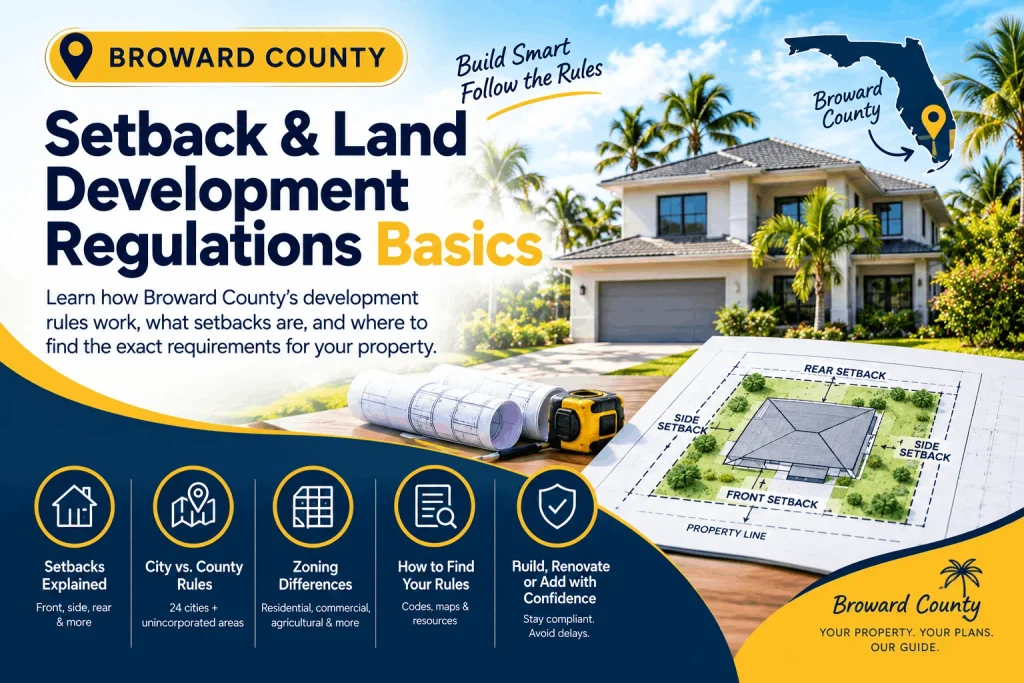
A setback is the minimum distance a structure must be located from a property line, right-of-way, or other reference point such as a waterway. Setbacks typically apply separately to the front yard, side yards, and rear yard, and they can vary further based on:
- The zoning district (single-family residential, multifamily, commercial, industrial, agricultural)
- Lot size, lot width, and whether the lot is a corner lot or an interior lot
- The type of structure (principal building vs. accessory structure like a shed, pool, or garage)
- Proximity to a canal, waterway, or environmentally sensitive area
- Building height, since taller structures often require larger setbacks
Setbacks exist for practical and safety reasons: preserving light and air between structures, maintaining privacy between neighbours, protecting sight lines at intersections, allowing space for utilities and drainage, and preventing overcrowding of a lot relative to its size.
Setbacks in Unincorporated Broward County
For property located in unincorporated Broward County, setback requirements come from Chapter 39 of the Broward County Code of Ordinances. Requirements vary significantly by zoning district. A few examples illustrate the range:
- Agricultural districts (A-1 Agricultural Estate and A-1 General Agricultural): A front yard of at least 50 feet is generally required for residential dwellings and accessory buildings. On plots under five net acres, farm buildings must generally sit at least 50 feet from any plot line, or be screened with an opaque buffer at least six feet high. On plots of five acres or more, farm buildings and structures are exempt from a required setback.
- Municipal boundary abutment: Any setback, separation, or distance limitation that applies to unincorporated land also applies where that unincorporated land abuts a municipal jurisdiction, treated as if the municipal land were unincorporated for that purpose.
- Administrative setback waivers: The county code includes a formal administrative setback waiver process, allowing property owners to apply for relief from a strict setback requirement under defined circumstances, rather than requiring every deviation to go through a full variance hearing.
Because unincorporated Broward County contains a mix of residential, agricultural, and conservation zoning districts, it’s essential to identify the exact zoning classification for a parcel before assuming a specific setback number.
Setbacks in Broward County’s Incorporated Cities
Each of Broward’s 24 cities sets its setback standards through its individual zoning code or ULDC/ULDR. While the specific numbers differ from city to city, most municipal codes follow a similar general structure for common residential situations:
| Structure Type | Typical Setback Pattern (varies by city and zoning district) |
| Principal single-family dwelling, front yard | Commonly in the range of 15–25+ feet from the front property line, depending on zoning district |
| Principal single-family dwelling, side yard | Commonly in the range of 5–10+ feet per side, depending on lot width and zoning district |
| Principal single-family dwelling, rear yard | Commonly in the range of 10–25+ feet, depending on zoning district and lot depth |
| Attached garage (single-family) | Often around 20 feet from the front property line under many municipal codes |
| Carport (single-family, open-sided) | Often around 15 feet from the front property line, with height and size limits |
| Fences, walls, and hedges | Setback typically depends on height and transparency (openness); taller, more opaque structures generally require greater setback from the property line |
| At-grade decks | Often permitted with no required setback if height stays below the ground floor elevation |
| Above-grade decks | Often require a minimum setback (commonly around 5 feet) and a height limit near the ground floor elevation |
| Docks (accessory, same lot as residence) | Often a minimum of around 5 feet from side property lines |
These figures are illustrative patterns drawn from multiple Broward municipal codes and are not a substitute for checking your specific city’s current code, since exact numbers vary by zoning district, lot classification, and any site-specific overlay regulations.
Key Land Development Concepts Beyond Setbacks
Setbacks are only one piece of the land development puzzle. Several related concepts commonly appear alongside setback requirements in both county and municipal codes:
- Lot coverage and Floor Area Ratio (FAR): Limits on how much of a lot can be covered by buildings, or how much total floor area a structure can have relative to lot size.
- Building height limits: Maximum structure height, often tied to zoning district and sometimes to proximity to the coast or airport flight paths.
- Site plan review: Many jurisdictions require formal site plan approval for new construction or significant additions, evaluating parking, circulation, landscaping, and design in addition to setback compliance.
- Landscaping and buffer requirements: Minimum landscaping, tree preservation, and buffering standards between differing land uses (for example, residential next to commercial).
- Sign regulations: Separate, detailed rules governing sign type, size, illumination, and placement, which also interact with setback lines in commercial and mixed-use zoning districts.
- Transportation Concurrency: Before a building permit can be issued anywhere in Broward County, applicants generally must obtain a Transportation Concurrency Satisfaction Certificate from the county’s Housing and Urban Planning Division, confirming the local transportation network can accommodate the development’s impact. No municipality may issue a building permit without this certificate in place, except for categories specifically exempted.
- Plat approval: Subdividing land, modifying plat conditions, or amending nonvehicular access lines requires review under the county’s Land Development Code, applicable in both unincorporated and incorporated areas for certain application types.
How Setback and Land Development Rules Interact With Broward’s Environment
Broward County’s flat, canal-laced, coastal geography adds a few additional layers to standard land development rules:
- Waterway setbacks: Where a property abuts a canal or other waterway, the setback is often measured differently than a standard property-line setback, following specific waterway-setback provisions in the applicable code.
- Minimum elevation requirements: Coastal and tidally influenced areas may carry minimum elevation standards for infrastructure, separate from FEMA flood zone requirements, aimed at long-term resilience against sea-level rise and tidal flooding.
- Required disclosures: Certain coastal or flood-prone areas require specific disclosures in real estate sale contracts related to elevation or environmental risk factors.
- High-Velocity Hurricane Zone (HVHZ) construction standards: Broward County, along with Miami-Dade County, falls within Florida’s High-Velocity Hurricane Zone, which imposes more stringent wind-load and structural requirements under the Florida Building Code than most other counties in the state. These standards apply on top of, not instead of, standard zoning setback requirements.
How to Find the Exact Setback Requirements for a Property
Because Broward’s rules are jurisdiction-specific, the process for confirming exact requirements generally follows these steps:
- Determine whether the property is in an incorporated city or unincorporated Broward County. This single determination decides which code book applies.
- Identify the property’s zoning classification. Zoning maps (available through the county or the relevant city’s planning department) show the specific zoning district, which drives every dimensional requirement including setbacks.
- Pull the applicable code section. For unincorporated areas, this means Chapter 39 of the Broward County Code of Ordinances. For incorporated areas, this means the relevant city’s zoning code or ULDC/ULDR, usually available through the city’s planning and zoning department or a code library service.
- Check for overlay districts or special regulations. Historic districts, coastal overlays, airport zones, and planned development districts can modify standard setback rules for a specific area.
- Request a zoning verification letter. Both the county and most cities offer a formal zoning verification process, providing written confirmation of a property’s zoning classification and applicable dimensional requirements — useful for real estate transactions, permitting, and dispute resolution.
- Consult the local zoning or building department directly. For unincorporated Broward properties, the county’s Zoning Division accepts direct inquiries by property address or folio number. For incorporated properties, the city’s own zoning administrator is the correct point of contact.
- Consider a licensed surveyor or land use attorney for complex situations. Corner lots, irregular lot shapes, waterway frontage, or nonconforming existing structures often benefit from professional review before finalizing building or renovation plans.

Variances, Waivers, and Nonconforming Lots
Not every lot fits neatly within standard setback dimensions, and Broward’s codes anticipate this in a few ways:
- Board of Adjustment relief: Where strict application of lot width, depth, area, or setback requirements creates unnecessary difficulty — particularly on corner lots or irregular interior lots — a Board of Adjustment can authorize alterations that still serve the underlying intent of the code.
- Administrative setback waivers: Some jurisdictions, including unincorporated Broward County, provide an administrative path for minor setback relief without requiring a full public hearing, streamlining smaller-scale adjustments.
- Nonconforming structures: Older buildings that predate current setback rules are often “grandfathered” as legally nonconforming, though substantial renovations or reconstruction after damage can sometimes trigger a requirement to bring the structure into current compliance.
Frequently Asked Questions
1. Does Broward County have one uniform setback rule for the entire county? No. Setback rules are set primarily at the municipal level for the 24 incorporated cities, while Broward County’s own zoning code (Chapter 39) applies only to unincorporated areas. Always confirm which jurisdiction governs a specific property first.
2. How do I know if my property is in unincorporated Broward County or inside a city? You can check through the Broward County Property Appraiser’s records, the county’s GIS/zoning mapping tools, or by contacting the relevant city or county zoning office directly with your address or folio number.
3. What’s the difference between the Broward County Zoning Code and the Broward County Land Development Code? The Zoning Code (Chapter 39) sets dimensional and use standards like setbacks for unincorporated areas. The Land Development Code (Chapter 5, Article IX) governs the development permit review process — including platting and Transportation Concurrency — and applies more broadly to certain applications across both unincorporated and incorporated areas.
4. Can setback requirements differ for the same zoning district in different Broward cities? Yes. Even similarly named residential zoning districts can carry different setback numbers from one city’s code to another, since each municipality adopts and amends its code independently.
5. What is a Transportation Concurrency Satisfaction Certificate, and do I need one? It’s a countywide requirement confirming the local transportation network can support a proposed development’s impact. No municipality in Broward County can issue a building permit without this certificate unless the project falls under a specific county-adopted exemption.
6. Are accessory structures like sheds, pools, or fences subject to the same setbacks as the main house? Not usually the same setback, but they are separately regulated. Accessory structures often have their own distinct setback rules, which can be more permissive than the primary structure’s setback but still vary by structure type, height, and zoning district.
7. What should I do if my lot doesn’t meet standard setback requirements due to its shape or size? Depending on the jurisdiction, you may be able to apply for Board of Adjustment relief or an administrative setback waiver. A licensed surveyor or land use professional can help determine which option fits your situation.
8. Do waterfront or canal-adjacent properties have different setback rules? Often, yes. Properties abutting a waterway may be subject to setback measurements specific to that waterway frontage, separate from standard property-line setbacks, and may also carry minimum elevation requirements in tidally influenced areas.
9. What is the High-Velocity Hurricane Zone, and how does it affect setbacks? The HVHZ is a Florida Building Code designation covering Broward and Miami-Dade Counties that imposes stricter wind-load and structural requirements. It doesn’t replace zoning setbacks, but adds construction standards on top of them.
10. Where can I get official confirmation of the setback requirements for my specific property? Request a zoning verification letter from the applicable jurisdiction — the Broward County Zoning Division for unincorporated properties, or the relevant city’s planning and zoning department for incorporated properties. This provides an official, written confirmation rather than relying on general code language alone.
Final Thoughts
Setback and land development regulations in Broward County reward careful, jurisdiction-specific research rather than assumptions based on a neighbouring city or a general rule of thumb. With 24 separate municipal codes plus a distinct set of rules for unincorporated areas, the single most important step before any building, renovation, or land use decision is confirming exactly which code applies to your property. Then, pull the specific zoning district requirements from that source. When in doubt, a zoning verification letter or a direct conversation with the applicable zoning office remains the most reliable way to avoid costly permitting delays or code violations down the road.