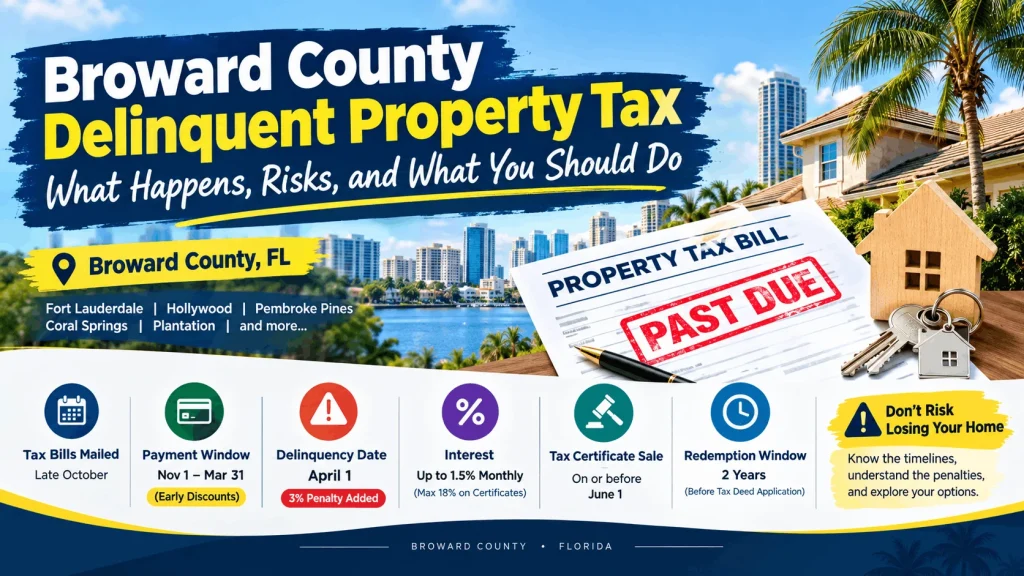
If you are searching for a Broward County FL property auction, it is important to understand that Broward County has more than one type of property auction. The two major categories are foreclosure property auctions and tax deed auctions. Although both involve real estate being sold through an auction process, they arise from different circumstances and have different research requirements.
Foreclosure sales are connected to court cases involving mortgage or other secured-property disputes. Broward County’s Clerk of Courts provides foreclosure-sale information and requires bidders to register through its online auction system. Tax deed auctions, on the other hand, are handled through Broward County’s Records, Taxes & Treasury Division and are associated with delinquent property taxes.
Before bidding on any Broward County property auction, buyers should carefully research the property, ownership information, court records, official records, taxes, liens, legal documents, and auction requirements.
This guide explains how Broward County property auctions work, where to find auction information, how to research a property, what bidders need to know about deposits and payments, and common mistakes to avoid.
What Is a Broward County Property Auction?
A property auction is a public sale in which real estate is offered to bidders according to a legal or administrative process.
In Broward County, the term “property auction” may refer to a foreclosure sale conducted through the court system or a tax deed sale conducted through the county’s tax deed process.
These two auction types should not be treated as the same thing.
| Auction Type | Why the Property Is Auctioned | Main Broward County Resource | Important Research |
| Foreclosure Auction | Mortgage or other secured debt foreclosure | Broward County Clerk of Courts | Court case, judgment, property records, liens |
| Tax Deed Auction | Delinquent property taxes and related tax certificate process | Broward County Records, Taxes & Treasury | Tax deed notice, property records, taxes, title issues |
| Live Foreclosure Sale | Certain court-ordered foreclosure sales | Broward County Clerk of Courts | Final judgment and court order |
| Online Foreclosure Sale | Electronic foreclosure auction | Broward County Real Foreclose platform | Registration, deposit, bid deadline, payment requirements |
The distinction matters because the procedures, documents, deposits, and potential risks can differ.
Broward County Foreclosure Property Auctions
A foreclosure auction occurs after a foreclosure case reaches the stage where the property is ordered to be sold.
The Broward County Clerk of Courts states that bidders participating in foreclosure sales must register through the county’s online foreclosure auction system. The Clerk also specifically states that bidders are responsible for conducting their research about the property.
The Clerk’s Circuit Civil Division handles cases including real property commercial foreclosures and real property mortgage foreclosures.
This means finding a foreclosure listing is only the beginning. A potential bidder should review the underlying court case and investigate the property before placing a bid.
How to Find Broward County Foreclosure Auctions
The first place to start is the Broward County Clerk of Courts.
The Clerk provides foreclosure-sale information and directs bidders to the online auction platform. Registration is required before participating in a sale.
You can also use the Clerk’s public case-search system to investigate foreclosure cases. The system includes numerous foreclosure-related civil case categories, including real property and mortgage foreclosure classifications.
A useful research process is:
Auction Listing → Case Number → Court Case → Property Address → Property Record → Official Records → Due Diligence
Do not rely only on the auction listing.
Broward County Tax Deed Auctions
A tax deed auction is different from a mortgage foreclosure auction.
Broward County’s Records, Taxes & Treasury Division is responsible for recording official land records and conducting tax deed auctions. The county provides links to its Real Auction tax deed auction system and legal notices for tax deed auctions.
Tax deed notices can contain important information such as:
- Property ID
- Tax deed number
- Certificate number
- Property description
- Assessed owner
- Legal titleholder information
- Auction date
- Pre-bidding information
- Minimum bid
- Auction website
- Special conditions
For example, Broward County tax deed notices identify the property and auction information and state that pre-registration is required to bid. The notices can also identify the minimum bid and certain obligations associated with the successful bidder.
Why Tax Deed Auctions Need Careful Research
A tax deed auction should not be viewed simply as a way to buy a property cheaply.
The official tax deed notice may contain conditions that affect the buyer. For example, Broward County tax deed notices have stated that successful bidders are responsible for outstanding taxes in the circumstances described in the notice.
Potential buyers should therefore read the specific tax deed notice and investigate the property before bidding.
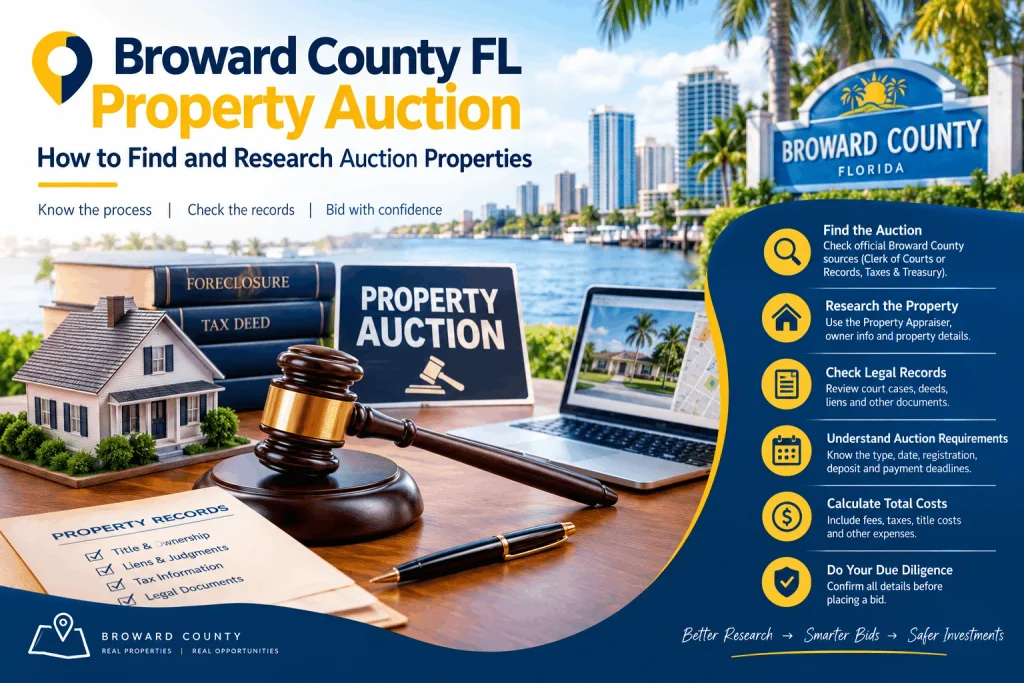
Where to Search Broward County Property Auctions
Several official resources can be used together when researching auction properties.
1. Broward County Clerk of Courts
The Clerk is the primary source for foreclosure sales and foreclosure court cases.
The Clerk’s foreclosure-sale page explains registration, deposits, payment requirements, and other procedures for foreclosure auctions.
You can also use the Clerk’s public case search to investigate foreclosure cases by party name and other available search criteria.
2. Broward County Property Appraiser
The Broward County Property Appraiser is useful for researching the property itself.
The official property-search and mapping tools provide information such as the folio number, owner, situs address, legal description, land value, building value, taxable value, sale history, and other property characteristics.
This information can help you connect an auction listing to the correct parcel.
3. Broward County Official Records
Official Records are another important part of auction research.
Broward County’s Official Records search system allows searches by name, book/page, document type, instrument number, case number, consideration amount, recording date, and parcel ID.
Recorded documents may include:
- Deeds
- Mortgages
- Liens
- Assignments
- Lis pendens
- Judgments
- Releases
- Other property-related documents
These records can help you understand the property’s recorded history.
4. Broward County Records, Taxes & Treasury
The county’s Records, Taxes & Treasury Division is especially important for tax deed auctions and official land records.
The county identifies this division as the statutory repository for official records and states that it conducts tax deed auctions.
How to Search a Broward County Auction Property
Once you find a property that interests you, follow a structured research process.
Step 1: Record the Property Address
Start by writing down the complete property address shown in the auction information.
If available, also record:
- Property ID
- Folio number
- Owner name
- Case number
- Auction date
- Auction type
Keeping these identifiers together makes the next searches easier.
Step 2: Search the Property Appraiser
Search the address, owner, or folio number through the Broward County Property Appraiser.
Confirm that the auction property matches the correct parcel.
Review the property’s:
- Owner
- Address
- Folio number
- Legal description
- Property type
- Building information
- Lot information
- Assessed value
- Taxable value
- Sale history
The Property Appraiser’s mapping system provides parcel information and allows searches using owner name, folio number, and address.
Step 3: Search the Foreclosure Case
If the property is being sold through a foreclosure auction, search the Broward County Clerk of Courts.
Use the available information to locate the case.
Useful identifiers may include:
- Case number
- Plaintiff name
- Defendant name
- Property owner
- Foreclosure case type
Review the case status and available court documents.
Remember that an online case search is not necessarily a complete substitute for reviewing the entire court record. Some records can have access restrictions.
Step 4: Search Official Records
Next, search the Broward County Official Records system.
Search using the owner name, case number, parcel ID, or other available information.
Look for documents such as mortgages, deeds, liens, lis pendens, judgments, assignments, and releases.
The Official Records system supports searches by several fields, including name, document type, case number, date recorded, and parcel ID.
Step 5: Check the Auction Details
Before bidding, return to the actual auction listing.
Verify:
- Auction date
- Property address
- Case or tax deed number
- Minimum or opening bid information
- Registration deadline
- Deposit requirements
- Payment deadline
- Auction status
Auction dates can change, so an old listing or third-party website should not be treated as the final source.
Broward County Foreclosure Auction Deposit Requirements
One of the most important things to understand before bidding is the required deposit.
The Broward County Clerk states that foreclosure-sale bidders must place a deposit equal to 5% of the estimated highest bid for each property they anticipate winning. The deposit must be received no later than 3:00 p.m. Eastern Time on the previous business day of the auction.
The Clerk states that deposits may be made by wire transfer or in person using accepted forms such as cash, cashier’s check, or money order, subject to the Clerk’s procedures.
Because requirements can change, bidders should verify the current instructions directly with the Clerk before sending funds.
What Happens After Winning a Foreclosure Auction?
Winning the auction does not mean the buyer can simply wait to pay.
The Broward County Clerk states that the successful bidder must pay the balance of the final bid, along with applicable court registry fees, by 12:00 p.m. Eastern Time on the next business day following the sale, unless the judgment specifies a different deadline.
The Clerk also states that documentary stamp taxes may apply to the final bid amount.
Failure to make the required final payment can result in forfeiture of the deposit. The Clerk explains that the deposit may be used for certain costs and toward the final judgment under the applicable procedure.
This makes financial preparation extremely important.
Broward County Property Auction Fees and Costs
Auction buyers should budget for more than the winning bid.
Depending on the type of auction and transaction, additional costs may include:
- Auction deposits
- Court registry fees
- Documentary stamp taxes
- Recording costs
- Title-related expenses
- Property taxes
- Outstanding obligations
- Legal or professional due-diligence costs
For foreclosure sales, the Clerk currently lists court registry fees as 3% of the first $500 and 1.5% of each subsequent $100, according to its published foreclosure-sale instructions.
The Clerk also identifies a $70 foreclosure sale fee associated with electronic sales.
The exact financial obligations depend on the specific transaction, so buyers should verify all current fees before bidding.
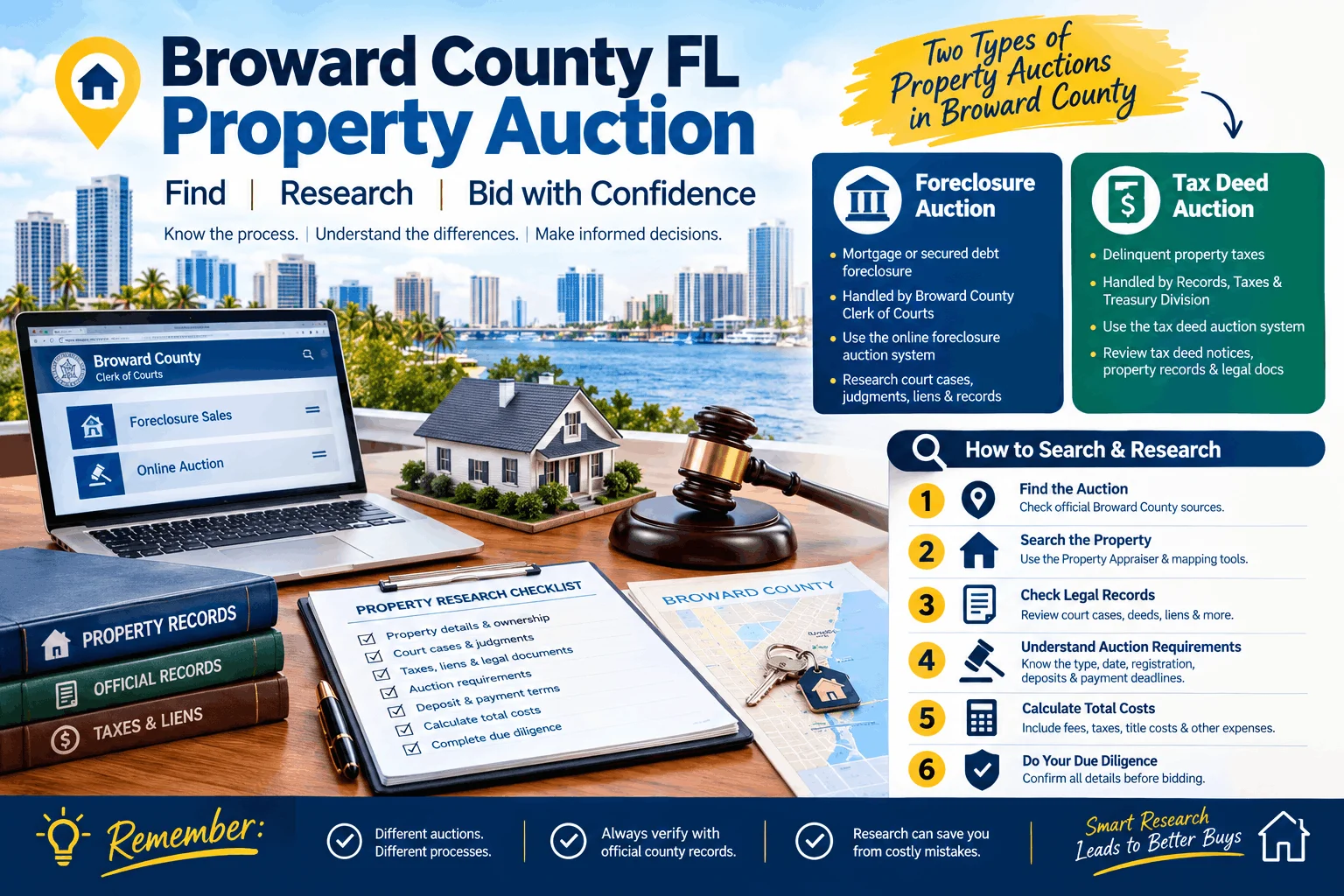
Foreclosure Auction vs. Tax Deed Auction
Understanding the difference between the two major auction types is essential.
| Feature | Foreclosure Auction | Tax Deed Auction |
| Main reason | Mortgage or secured-debt foreclosure | Delinquent property taxes |
| Primary resource | Clerk of Courts | Records, Taxes & Treasury |
| Court case | Usually central to the process | Tax deed process |
| Auction platform | Broward RealForeclose | Broward tax deed auction system |
| Deposit | Clerk requires 5% for foreclosure sale bidding | Follow the current tax deed auction instructions |
| Property research | Court + property + official records | Tax deed notice + property + official records |
| Main risk | Legal status, liens, property condition, bidding competition | Tax/title issues, property condition, legal interests |
| Due diligence | Essential | Essential |
The county’s Records, Taxes & Treasury Division specifically identifies tax deed auctions as one of its responsibilities, while the Clerk of Courts handles foreclosure sales.
Common Mistakes When Buying at a Broward County Property Auction
Mistake 1: Looking Only at the Auction Price
A low opening or minimum bid does not tell you the property’s total financial picture.
Research taxes, recorded documents, legal issues, and potential property expenses before deciding how much you are prepared to bid.
Mistake 2: Confusing Foreclosure With Tax Delinquency
A mortgage foreclosure and a tax deed sale are different processes.
Always determine which type of auction you are researching.
Mistake 3: Using Only Third-Party Auction Websites
Third-party websites can be useful for discovering properties, but auction information should be checked against the appropriate Broward County official source.
Mistake 4: Ignoring the Property Record
An auction listing may not tell you everything about the property.
Use the Property Appraiser to confirm the parcel, ownership information, property characteristics, and sale history.
Mistake 5: Not Checking Official Records
Recorded documents can provide information that is not obvious from an auction listing.
Search the official records before bidding.
Mistake 6: Assuming the Auction Date Is Final
Foreclosure cases can change, and scheduled sales can be affected by court activity.
Always confirm the current auction information before transferring money or bidding.
Mistake 7: Failing to Research the Property’s Physical Condition
Public records can tell you a great deal about a property, but they do not necessarily provide a complete picture of its current physical condition.
If legally and practically possible, investigate the property’s condition before bidding.
Broward County Property Auction Research Checklist
Before participating in a Broward County property auction, use this checklist:
Property
- Confirm the address
- Confirm the folio or property ID
- Check the legal description
- Review property characteristics
- Review sales history
Legal Records
- Find the foreclosure case if applicable
- Check case status
- Review available judgments and orders
- Search deeds and mortgages
- Search liens and other recorded documents
- Check for lis pendens and related filings
Auction
- Confirm the auction type
- Verify auction date
- Confirm registration requirements
- Review deposit requirements
- Confirm payment deadline
- Check current auction status
Financial Research
- Determine your maximum bid
- Calculate the required deposit
- Budget for applicable fees
- Consider taxes and other expenses
- Allow room for unexpected costs
Final Thoughts
A Broward County FL property auction can involve significant financial and legal considerations, so researching the property before bidding is essential.
The most important step is to identify what type of auction you are looking at. Foreclosure auctions are connected to court foreclosure proceedings and are handled through the Broward County Clerk of Courts. Tax deed auctions are part of the county’s tax deed process and are handled through Records, Taxes & Treasury.
For foreclosure properties, start with the Clerk’s auction and case information. For tax deed properties, review the tax deed notice and county auction information. Then use the Broward County Property Appraiser to verify the parcel and property details and use Official Records to research recorded documents.
The basic research process is:
Find the auction → identify the property → verify the parcel → research the legal records → review official documents → check auction requirements → calculate your total costs → complete due diligence before bidding.
A property auction should never be treated as simply a search for the lowest price. The winning bid is only one part of the transaction. Current auction status, property condition, taxes, recorded documents, legal issues, fees, and payment deadlines can all affect the actual cost and risk of a purchase.
Because auction information and individual cases can change, always verify important details using the most current official Broward County records and auction information before registering, transferring funds, or placing a bid.
Frequently Asked Questions About Broward County Property Auctions
Where can I find Broward County property auctions?
For foreclosure auctions, start with the Broward County Clerk of Courts and its foreclosure-sale information. For tax deed auctions, use Broward County Records, Taxes & Treasury resources and the county’s tax deed auction system.
Are Broward County property auctions online?
Foreclosure sales are conducted online through the Broward County foreclosure auction platform unless a particular sale is ordered as a live sale. The Clerk provides registration and payment instructions for online foreclosure sales.
Broward County also provides an online tax deed auction system.
How much is the foreclosure auction deposit?
The Broward County Clerk currently states that bidders must deposit 5% of the estimated highest bid for each property they anticipate winning. The deposit must be received by the specified deadline before the auction.
Can I research a property before bidding?
Yes. You should research the property before bidding. Useful sources include the Broward County Property Appraiser, Clerk of Courts, and Broward County Official Records. The Clerk specifically states that bidders are responsible for conducting their own research.
Is a tax deed auction the same as a foreclosure auction?
No. A tax deed auction is associated with delinquent property taxes and is administered through Broward County’s Records, Taxes & Treasury Division. A foreclosure auction is connected to a foreclosure case and is handled through the court system.
What information should I collect before bidding?
At minimum, collect the property address, parcel or folio number, owner information, auction date, case or tax deed number, auction type, and available legal and recorded-document information.
What happens if I win a foreclosure auction but do not pay?
The Broward County Clerk states that failure to make the required final payment by the applicable deadline can result in forfeiture of the deposit and assessment of certain costs.