If you own property in Broward County, whether in Fort Lauderdale, Hollywood, Pembroke Pines, Coral Springs, Plantation, or anywhere else in the county, missing a property tax deadline sets off a chain of events that can escalate quickly. Because Florida handles delinquent taxes very differently from many other states, relying on a tax certificate and tax deed system rather than a straightforward courthouse foreclosure lawsuit, it’s easy for owners to misunderstand how much time they actually have, and when the real point of no return arrives. Understanding the timeline, the penalties, and your options early can mean the difference between a manageable payoff and losing your property years down the line. Here is what every Broward County property owner should know.
Broward County Delinquent Property Tax at a Glance
| Category | Details |
| Tax bills mailed | Late October |
| Payment window | November 1 through March 31, with early payment discounts |
| Delinquency date | April 1 |
| Initial penalty | 3 percent added on April 1 |
| Monthly interest | Up to 1.5 percent, with a statutory cap of 18 percent on tax certificates |
| Tax certificate sale | Held on or before June 1 each year |
| Certificate redemption window | 2 years from the delinquency date before a tax deed application can be filed |
| Post auction redemption | None, once a tax deed is issued the sale is final |
| Where to pay | Broward County Tax Collector |
| Where to check exemptions | Broward County Property Appraiser (BCPA) |
When Property Taxes Become Delinquent in Broward County
Property taxes in Florida are billed each year in the fall and become payable on November 1, with the full amount due by March 31 of the following year without penalty. Paying earlier in the season actually earns a discount, so many homeowners pay well before the deadline.
The Key Dates to Remember
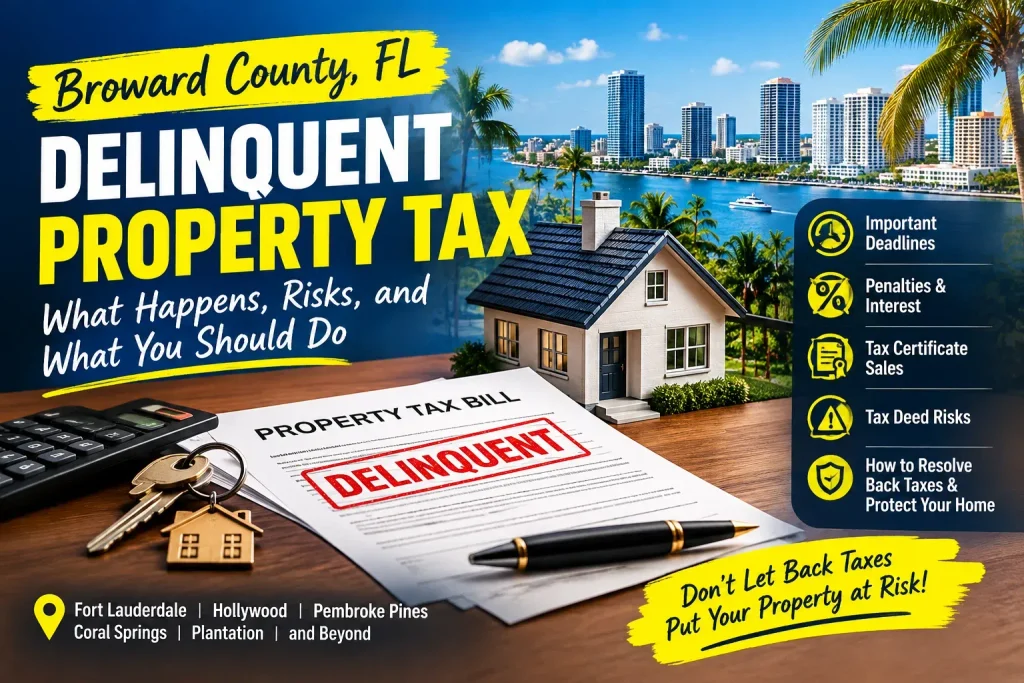
January 1: This is the assessment date, the point in time used to determine the property’s value and ownership for that tax year.
November 1 through March 31: The standard payment window. Discounts apply for early payment, starting at 4 percent in November and stepping down each month until the full amount is due with no discount by March 31.
April 1: Taxes not paid by this date are officially delinquent, and a 3 percent penalty is added immediately.
May: Delinquent parcels are advertised in a local newspaper for three consecutive weeks ahead of the tax certificate sale, with the advertising costs added to the balance owed.
On or before June 1: The Broward County Tax Collector holds its annual Tax Certificate Sale, an online auction where investors bid on the right to pay off the delinquent balance.
Two years from the delinquency date: The earliest point at which an unredeemed certificate holder can apply for a tax deed, which sets the stage for a public auction of the property itself.
How Penalties and Interest Add Up
Once your account is delinquent, a 3 percent penalty is added on April 1, and interest continues to accrue monthly at up to 1.5 percent until the balance is resolved. When the county’s tax certificate auction takes place, bidding starts at a statutory maximum of 18 percent annual interest, and investors compete by bidding that rate down, sometimes to a fraction of a percent on desirable properties. Even at a very low bid rate, Florida law guarantees certificate holders a minimum return of 5 percent when a certificate is redeemed, except for certificates originally bid at 0 percent.
In other words, once your taxes are sold as a certificate, a third party investor now holds a lien on your property and stands to earn interest on your debt until you pay it off, and the amount owed keeps growing the longer it goes unresolved. If no investor bids on a particular certificate at the auction, it isn’t simply canceled. Instead, it’s struck off to the county itself and continues to accrue interest at the statutory 18 percent rate, which means the debt keeps climbing even without a private buyer involved.
The Risks of Letting Property Taxes Go Unpaid
Tax Certificates, Not a Courthouse Foreclosure Lawsuit
Unlike some states, Florida doesn’t rely on the county filing a foreclosure lawsuit against a delinquent owner. Instead, the Broward County Tax Collector sells a tax certificate, essentially a lien representing the unpaid taxes, penalties, and fees, to the investor willing to accept the lowest interest rate. The certificate itself is not a sale of the property. It simply transfers the right to collect the debt, with interest, from a government office to a private bidder.
The Two Year Countdown to a Tax Deed
If a certificate remains unredeemed, the certificate holder must wait a minimum of two years from the date the taxes became delinquent before applying for a tax deed. Filing that application triggers a public auction of the property itself, conducted by the Broward County Clerk of Courts. At that tax deed auction, the property goes to the highest bidder, who must at least cover the certificate amount, accrued interest, and various statutory fees and costs.
Redemption Happens Before the Sale, Not After
This is one of the biggest differences from states that use a courthouse foreclosure and post sale redemption process. In Florida, a property owner can redeem the property at any point before the county actually issues a tax deed to a winning bidder, which includes the two year certificate period and, in many cases, right up to the point of the auction itself. Once the tax deed is issued, however, the sale is final. There is no post auction redemption period in Florida the way some other states allow former owners to reclaim property after a sale closes, so the real window to act is everything leading up to that deed issuance, not after it.
Homestead Protections at the Tax Deed Auction
Florida’s constitution provides added protection for a homesteaded property even at the tax deed stage. When a homestead property goes to auction, the opening bid must generally cover not just the certificate amount and accrued interest, but also an amount tied to half of the property’s assessed value, plus other outstanding taxes and fees. This tends to result in a meaningfully higher starting bid than on a non homestead property. If the property ultimately sells for more than what was owed, the former owner may be entitled to claim the excess proceeds through the Clerk of Courts, though this requires a separate claims process and isn’t automatic.
Complications With Title and Financing
Delinquent taxes create a lien that takes priority over most other claims on the property, including mortgages. This can complicate refinancing, selling, or transferring the property until the debt is cleared, and it can create title issues that surface unexpectedly during a future transaction, particularly if a tax certificate has already been sold to an investor. If your mortgage is escrowed, your lender typically pays the tax bill directly from that account each year, but that only works if the escrow analysis is accurate and funded, so it’s worth confirming with your servicer that your taxes are actually being paid rather than assuming they are.
What You Should Do if You’re Facing Delinquent Property Taxes
Don’t Wait to Address It
Because penalties and interest accrue quickly, and because a tax certificate can be sold to an outside investor as early as June following the delinquency, the cost and complexity of resolving unpaid taxes only grows over time. Reaching out to the Broward County Tax Collector’s office as soon as possible, ideally well before the spring payment deadline, can help you avoid the certificate sale altogether and keep more options on the table. Waiting until after a certificate has already been sold doesn’t eliminate your ability to redeem the property, but it does mean you’re now paying off a private investor’s bid down interest rate on top of the original taxes, penalties, and fees.
Understand Your Payoff Options
Broward County does not offer a formal installment repayment plan for taxes that have already gone delinquent and had a certificate sold against them. Once a certificate exists, the outstanding balance, including the bid down interest rate, generally needs to be paid in full to redeem the property. Florida does offer a separate quarterly installment plan for homeowners who want to prepay the following year’s taxes in smaller amounts, but that program is for staying current, not for catching up on a balance that’s already delinquent.
Look Into a Tax Deferral if You Qualify
Homeowners who are elderly, disabled, or meet certain income limits may be able to defer a portion of their property tax bill under Florida’s homestead tax deferral program. A deferral doesn’t erase the debt, but it can pause the obligation to pay currently while it’s in place, though interest continues to accrue, and the deferral ends if the property is sold or the homestead exemption is no longer in place.
Verify Your Exemptions Are Current
Losing a homestead or other exemption unexpectedly can trigger a larger than expected bill and, in cases involving an exemption a homeowner wasn’t actually entitled to, back taxes and penalties. Confirming your exemptions with the Broward County Property Appraiser each year can help you avoid surprises.
Get a Professional Title Review
If you’re buying, selling, refinancing, or simply want clarity on where a property stands, a title search can uncover any existing tax certificates, delinquent balances, or other encumbrances before they become a bigger problem. This is especially important for anyone purchasing a property that may have a history of delinquent taxes, since unresolved certificates and liens can follow the property even after a sale closes. A thorough search can also flag whether a certificate holder is approaching the two year mark where a tax deed application becomes possible, which is critical information for a buyer trying to assess risk before closing.
Consider How Bankruptcy or a Life Event Might Affect Timing
Filing for bankruptcy, dealing with a probate matter, or other legal proceedings can affect how and when a tax certificate can be enforced against a property, since Florida law accounts for these situations when calculating interest and setting deadlines. If you’re facing delinquent taxes alongside another significant legal or financial issue, it’s worth discussing the interaction between the two with a qualified professional rather than assuming the standard timeline applies exactly as described here.
How a Title Company Can Help
Navigating delinquent property tax issues, whether you’re a current owner trying to protect your home or a buyer evaluating a purchase, is easier with a clear picture of the title. A qualified title company can help you review outstanding certificates and liens, understand how delinquent taxes affect a transaction, and move forward with confidence. This kind of review is particularly valuable in Broward County given how quickly a certificate can be sold and how much a property’s payoff amount can shift once outside interest starts compounding. Reach out to a local Broward County title company to get started before a routine transaction turns into a complicated one.
Frequently Asked Questions
When do property taxes become delinquent in Broward County? Taxes become delinquent on April 1 of the year following the tax bill, after the November 1 through March 31 payment window closes.
What penalties apply to delinquent Broward County property taxes? A 3 percent penalty is added on April 1, and monthly interest continues to accrue. Once a tax certificate is sold, interest can be as high as 18 percent, the rate at which the county’s auction begins.
Does Broward County foreclose on delinquent property like Texas does? No. Florida uses a tax certificate and tax deed system rather than a courthouse foreclosure lawsuit. The county sells a certificate representing the unpaid debt, and only after two years of nonredemption can the certificate holder apply for a tax deed and force a public auction of the property.
Can I get my property back after a tax deed sale in Broward County? No. Unlike some states that allow redemption after a sale, Florida requires redemption to happen before the tax deed is issued. Once the deed is issued to the winning bidder, the sale is final.
Is there a payment plan for delinquent taxes in Broward County? Not in the traditional sense. Once a certificate has been sold, the balance generally must be paid in full to redeem the property. Florida’s quarterly installment program is meant for prepaying upcoming taxes, not resolving a delinquent balance.
What should I do first if my Broward County property taxes are delinquent? Contact the Broward County Tax Collector as soon as possible, ideally before a certificate is sold in the spring or early summer, and confirm your homestead and other exemptions are correctly applied through the Broward County Property Appraiser.
Who actually buys my debt when a tax certificate is sold? Private investors bid at the annual auction, competing by accepting the lowest interest rate they’re willing to earn. If no investor bids on a particular parcel, the certificate is struck off to the county itself rather than going unsold.
Does having a homestead exemption protect me from losing the property? It doesn’t prevent a tax certificate from being sold or a tax deed application from eventually being filed, but Florida’s constitution does require a higher opening bid at the tax deed auction for homestead property, and any sale proceeds above what’s owed may be claimable by the former owner.
Can delinquent taxes affect a sale or refinance that’s already in progress? Yes. A tax lien takes priority over most other claims, including mortgages, so an unresolved delinquency or an outstanding tax certificate can delay or derail a closing until the title is clear.