
A mistake on your property record can create problems when you are paying property taxes, applying for an exemption, refinancing your home, or preparing to sell. Something as simple as incorrect square footage, an outdated ownership record, a missing homestead exemption, or inaccurate property characteristics may need to be reviewed and corrected.
If you own property in Broward County, Florida, you can check your property information through the Broward County Property Appraiser (BCPA) and compare it with your deed, surveys, permits, and other supporting documents.
The important thing is to identify what information is actually wrong and which government office is responsible for it. The Property Appraiser handles property assessment information and exemptions, while recorded deeds and other official documents are handled through Broward County’s records system.
This guide explains how to find an error, gather supporting evidence, contact the appropriate office, and understand when the Value Adjustment Board (VAB) may become involved.
What Information Appears on a Broward County Property Record?
A Broward County property record can contain a variety of information used for property assessment and tax-roll purposes. Depending on the record, you may see information such as:
- Property owner name
- Folio or parcel identification number
- Property address
- Legal description
- Land value
- Building value
- Total assessed value
- Taxable value
- Homestead exemption information
- Other exemptions
- Building square footage
- Property characteristics
- Sale information
- Property use information
The BCPA property mapping system allows users to search using a parcel ID, owner name, or address and view information such as the owner, situs address, values, exemptions, sale information, and building square footage.
Because this information can change after a sale, renovation, exemption application, or assessment, it is a good idea to review your property record periodically instead of assuming that every field is correct.
Common Errors Found on Broward County Property Records
Not every discrepancy is handled in the same way. The first step is determining exactly what appears to be incorrect.
1. Incorrect Owner Name
An owner’s name may appear differently from the name shown on a recently recorded deed. Sometimes the difference is simply a spelling or formatting issue. In other cases, the underlying recorded document may need attention.
If the problem originates from a recorded deed or another official document, the Property Appraiser may not be the office that can correct the underlying legal document.
2. Incorrect Square Footage
Property characteristics can sometimes contain information that does not match your actual property.
For example, you may discover that the listed building square footage differs from your survey, building plans, or permitted improvements.
If you believe the property characteristics are inaccurate, gather documentation showing the correct information before contacting the Property Appraiser.
3. Incorrect Room or Building Information
Other characteristics may also appear incorrectly, such as room counts, building details, property use, or other characteristics used in the appraisal process.
The exact evidence needed depends on the type of information being challenged. Permits, surveys, photographs, architectural documents, and other records may help support your request.
4. Missing Homestead Exemption
A property owner may discover that an expected homestead exemption is not shown on the property record.
Broward County’s Property Appraiser provides information about homestead and other exemptions, including application deadlines. For the 2026 tax year, the timely filing deadline was March 2, 2026, with a statutory late-filing deadline of September 18, 2026.
Exemption situations can be different depending on the type of exemption and whether the Property Appraiser denied or removed an exemption, so check the specific instructions for your situation.
5. Incorrect Assessed or Market Value
A disagreement with the property’s value is different from a simple factual correction.
The Property Appraiser determines property value for the tax roll, but it does not set the tax rates or collect the property tax bill. Broward County explains that the tax bill is based on taxable value, millage rates, and applicable special assessments.
If you believe the assessed value is incorrect, you should first review the information and discuss the valuation with the Property Appraiser. If the disagreement remains unresolved, the Value Adjustment Board provides the formal petition process for disputes involving valuation, exemptions, and classifications.
Step 1: Find Your Current Broward County Property Record
Before requesting a correction, start with the information currently shown by the Broward County Property Appraiser.
You can search using information such as:
- Property address
- Owner name
- Folio number
- Parcel or property ID
The BCPA system supports property searches using several parcel identifiers and search methods.
Once you locate the correct property, write down the folio number or property ID. This number is useful when communicating with the Property Appraiser because it identifies the specific parcel involved.
Do not rely only on the property’s street address. Addresses can sometimes be formatted differently across records, while the parcel identifier provides a more precise reference.
What Should You Check?
Go through the property record carefully and compare the information with your own documents.
Pay particular attention to:
- Owner information
- Property address
- Building square footage
- Property characteristics
- Land information
- Sale information
- Assessed value
- Taxable value
- Homestead exemption
- Other exemptions
- Property classification or use
The goal is to identify a specific discrepancy, rather than simply deciding that the property tax bill seems too high.
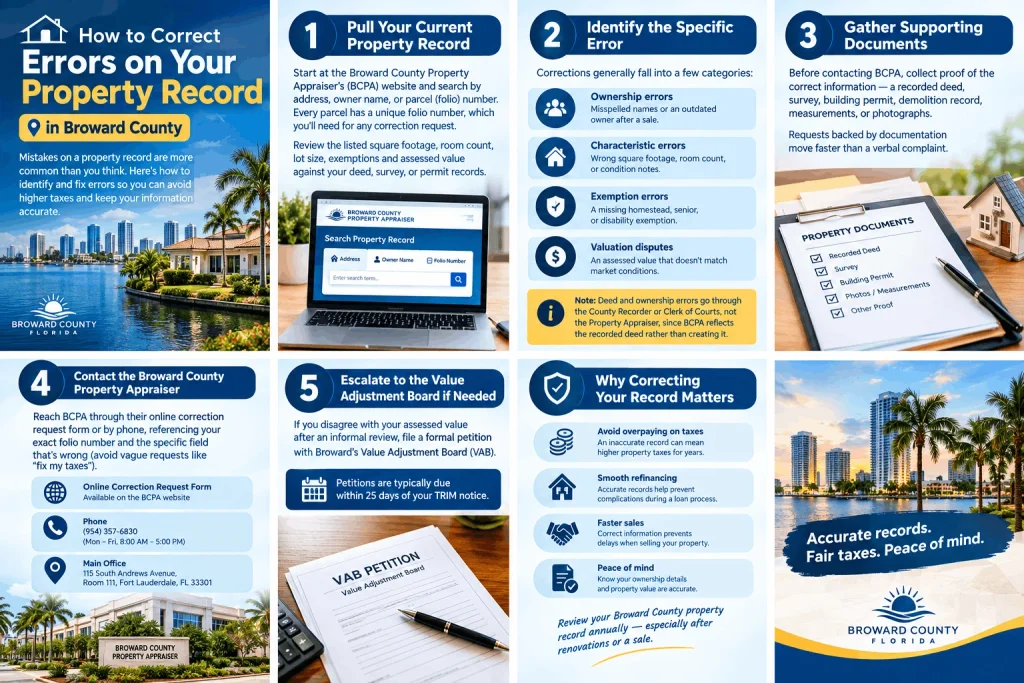
Step 2: Determine What Type of Error You Have
Once you find a discrepancy, classify it before contacting an office.
This makes the correction process much easier.
| Error or Dispute | Where to Start | Helpful Documentation |
|---|---|---|
| Incorrect property characteristic | Broward County Property Appraiser | Survey, permit, plans, photographs |
| Wrong square footage | Broward County Property Appraiser | Survey, building records, measurements |
| Missing exemption | BCPA Exemptions Division | Residency or eligibility documentation |
| Disputed assessed value | BCPA, then VAB if necessary | Comparable sales, appraisal evidence |
| Recorded deed or ownership issue | Broward County official records/appropriate recording authority | Recorded deed or corrective document |
| Recording error in an official document | Appropriate records authority | Original document and corrective documentation |
The distinction matters because the Property Appraiser’s records are used for property appraisal and tax-roll purposes, while official recorded documents such as deeds are maintained through the county’s records system. Broward County identifies its Records, Taxes and Treasury function as the source for official recorded documents, mortgages, and deeds, while the Property Appraiser provides property-record information.
Step 3: Gather Documents That Prove the Correct Information
Do not contact the Property Appraiser with only a general statement such as, “My property information is wrong.”
Instead, explain exactly what is incorrect and provide evidence whenever possible.
Depending on the issue, useful documents may include:
- Recorded deed
- Survey
- Building permit
- Certificate or construction records
- Architectural plans
- Property measurements
- Photographs
- Closing documents
- Exemption documentation
- Appraisal report
- Comparable property information
- Other official records
For example, if the BCPA record shows 2,800 square feet but your supporting documents indicate 2,400 square feet, clearly identify the discrepancy and provide the documentation supporting the 2,400-square-foot figure.
Keep copies of everything you submit.
It is also useful to create a simple record of:
- The date you identified the problem
- The information currently shown
- The information you believe is correct
- The documents supporting your position
- The date you contacted the office
- Any response you received
This creates a useful paper trail if the issue takes more than one communication to resolve.
Step 4: Contact the Broward County Property Appraiser
For property characteristics, assessments, exemptions, and other information within the Property Appraiser’s responsibility, contact the Broward County Property Appraiser.
BCPA lists its main office at:
Broward County Property Appraiser
115 S. Andrews Avenue, Room 111
Fort Lauderdale, FL 33301
BCPA also lists its customer service phone number as 954-357-6830 and states that its office is open weekdays from 8 a.m. to 5 p.m.
When contacting the office, have your folio number available.
Instead of saying:
“My taxes are wrong.”
Give a specific explanation such as:
“The property record for folio number [number] lists the building at [listed square footage], but my survey shows [correct square footage]. I would like the property characteristic reviewed.”
A specific request gives the office a clear issue to investigate.
Do Not Confuse the Property Appraiser With the Tax Collector
This distinction is important.
The Property Appraiser determines property values and administers exemptions for the tax roll. It does not set tax rates or collect property taxes.
Broward County states that the Tax Collector handles property-tax billing and collection, while taxing authorities establish millage rates and other charges.
Therefore, if your concern is specifically about a tax bill, millage rate, or a charge that is not related to the property’s assessed or taxable value, you may need to contact the appropriate taxing authority or Tax Collector rather than asking the Property Appraiser to “fix the tax bill.”

Why Correcting Your Record Matters
An inaccurate record can mean overpaying on taxes for years, complications during refinancing, or delays when selling. Reviewing your Broward County property record annually — especially after renovations or a sale — helps ensure fair taxation and accurate ownership details.
Error Type vs. Where to Fix It
| Error Type | Where to Fix It | What You’ll Need |
|---|---|---|
| Ownership / name error | County Recorder or Clerk of Courts | Recorded deed |
| Wrong square footage or room count | Broward County Property Appraiser (BCPA) | Survey, permit, or photos |
| Missing homestead/senior/disability exemption | BCPA exemptions department | Proof of residency/eligibility |
| Disputed assessed value | BCPA, then Value Adjustment Board (VAB) | Comparable sales, appraisal report |
| Deed recording mistake | County Recorder | Corrective deed filing |
Why Correcting Your Record Matters
An inaccurate property record does more than sit quietly in a database — it directly shapes your tax bill. If your square footage or exemptions are wrong, you could overpay year after year without realizing it. Errors also surface at the worst times: during a sale, a buyer’s title search can flag ownership discrepancies and delay closing; during a refinance, lenders often cross-check the county record against your application. Catching and fixing errors early protects your finances and keeps the paper trail clean for whoever handles your property next — whether that’s a buyer, a lender, or your own estate.
Conclusion
Your Broward County property record directly affects what you pay in taxes and how smoothly a future sale or refinance goes. A quick annual check — comparing your BCPA listing against your deed and any recent permits — costs nothing and can catch costly mistakes early. When something’s off, act on it: pull your folio number, gather your documents, and contact BCPA with the specific field that needs fixing rather than a general complaint. For valuation disputes, the Value Adjustment Board gives you a formal path to push back.
Frequently Asked Questions
How do I find my Broward County parcel (folio) number? Search your address or owner name on the BCPA website’s property search tool — the folio number appears at the top of your property record.
Can fixing a record error lower my property taxes? Sometimes. If the error affected your assessed value — like incorrect square footage — correcting it can lower your taxable value. A missing exemption works the same way.
How long does a correction request take? It varies, but requests backed by clear documentation (deed, survey, permit) are typically processed faster than ones without supporting proof.
What if BCPA denies my correction request? Valuation disputes can be escalated to the Value Adjustment Board. Ownership or deed errors need to be resolved through the County Recorder instead.
Is there a deadline to fix property record errors? There’s no deadline to report a factual error like wrong square footage, but VAB appeals on assessed value must be filed within 25 days of your TRIM notice.


