Transferring property ownership in Broward County, Florida is a legal process that requires proper documentation, execution of a valid deed, and official recording with the county. Whether the transfer is due to a property sale, family gift, inheritance, divorce, or ownership restructuring, the process must comply with Florida state law and Broward County recording requirements.
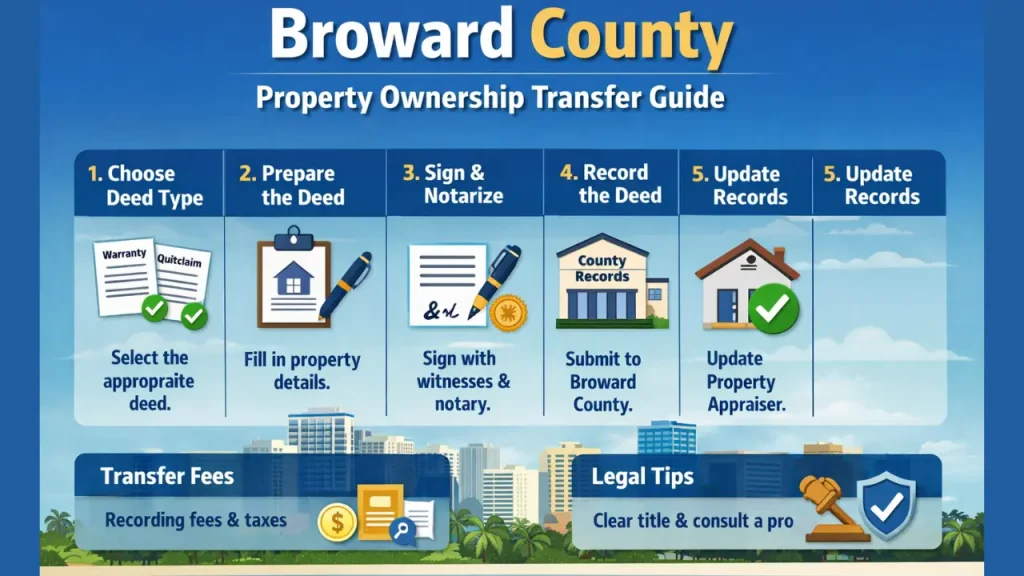
Table of Contents
What is Property Ownership Transfer in Broward County?
Property ownership transfer refers to the legal process of changing the title of a property from one person or entity to another. In Broward County, this transfer becomes official only when the deed is properly executed and recorded with the Broward County Records, Taxes, and Treasury Division.
A property deed is the legal document that proves ownership. When the deed is recorded, the new owner becomes the official legal owner in county records.
| Type of Transfer | Description | Tax / Legal Notes |
|---|---|---|
| Family Transfers | Property transferred between family members, usually using a quitclaim deed. | May qualify for reduced or minimal tax depending on conditions. |
| Property Sale Transfers | Standard real estate sale between buyer and seller. | Full documentary stamp tax usually applies. |
| Gift Transfers | Property given without payment, often between relatives. | May require federal gift tax reporting if value exceeds limits. |
| Divorce Transfers | Property division as part of divorce settlement. | Tax treatment depends on court order and transfer structure. |
| Trust or Entity Transfers | Transfer into or out of trusts or business entities. | May still trigger tax even if ownership control remains unchanged. |
Common Reasons for Property Transfer
Property ownership is commonly transferred in the following situations:
- Sale of real estate between buyer and seller
- Transfer of property between family members
- Gift of property to a relative or friend
- Divorce settlement or separation agreement
- Transfer into or out of a trust or business entity
- Inheritance or estate planning purposes
Each type of transfer may require different deed types and tax considerations.
Step-by-Step Broward County Property Transfer Process
Step 1: Choose the Correct Type of Deed
The first step is selecting the appropriate deed based on the type of transfer:
- Warranty Deed: Provides full legal guarantee of clear title
- Special Warranty Deed: Limited guarantee covering specific ownership period
- Quitclaim Deed: Transfers ownership without guaranteeing title validity, commonly used for family transfers
The deed type affects legal protection and future ownership rights.
Step 2: Prepare the Deed Document
The deed must be accurately prepared with complete legal details, including:
- Full legal names of grantor (current owner) and grantee (new owner)
- Property address
- Parcel identification number (Parcel ID)
- Legal description of the property
- Type of ownership being transferred
Any errors in this stage can delay or invalidate the transfer.
Step 3: Sign, Witness, and Notarize the Deed
For the deed to be legally valid in Florida:
- The grantor must sign the deed
- Two witnesses must be present during signing
- A licensed notary public must notarize the document
Without proper witnessing and notarization, the deed cannot be recorded.
Step 4: Record the Deed with Broward County
Once executed, the deed must be submitted to:
Broward County Records, Taxes, and Treasury Division
This can be done via mail or in person. Once recorded, the transfer becomes part of the official public record.
Recording is a critical step because ownership is not legally recognized until the document is officially recorded.
Step 5: Update Property Appraiser Records
After recording, the ownership information is forwarded to the Broward County Property Appraiser’s Office. This ensures:
- Property tax records are updated
- Homestead exemption eligibility is reviewed
- Ownership details are correctly reflected in county systems
Broward County Property Transfer Fees and Taxes
Property transfers in Broward County involve certain government fees and state taxes. These costs vary depending on the type and value of the transaction. To find Ownership record transfer fee callculator, Download Informational sheet and property tax calculator follow links below.
Important Legal Considerations
Before transferring property, several legal factors should be considered:
- The property title must be clear of disputes or unresolved liens
- Mortgage obligations may remain with the original borrower unless refinanced
- Incorrect deed preparation can cause ownership disputes
- Fraud protection programs like Owner Alert help monitor unauthorized changes
- Professional assistance from a title company or real estate attorney is recommended for complex transfers
Processing Time for Property Transfers
In Broward County, property deed recording typically takes:
- 4 to 6 business days for standard processing
- Faster processing may be available for in-person submissions
- Delays may occur if documents are incomplete or incorrect
Common Mistakes to Avoid
Many property transfer issues arise from simple errors such as:
- Using the wrong type of deed
- Missing witnesses or notarization
- Incorrect parcel ID or legal description
- Not calculating transfer tax correctly
- Failing to update property appraiser records
Avoiding these mistakes ensures a smooth and legally valid transfer.
Conclusion
The Broward County property ownership transfer process requires careful preparation, correct deed execution, and official recording with county authorities. Understanding the steps involved ensures a smooth transfer and helps avoid legal or financial complications.
For accurate cost estimation and tax calculation, always refer to a dedicated documentary stamp tax calculator or consult a qualified professional when dealing with high-value or complex property transfers.
FAQ’s
What is the legal requirement for property transfer in Broward County?
A properly executed and notarized deed must be recorded with the county.
Which deed is best for family property transfer?
A quitclaim deed is commonly used for transfers between family members.
Is documentary stamp tax required for all transfers?
Most transfers require it unless a specific exemption applies.
How long does it take to record a deed?
Typically 4 to 6 business days depending on submission method.
Can I transfer property without a lawyer?
Yes, but legal assistance is recommended for accuracy and tax compliance.