Zoning determines what you can legally build, operate, or convert a property into — and in Broward County, that answer depends heavily on exactly where the property sits. Between the county’s own zoning code and more than 30 incorporated cities each running their own regulations, “what’s my property zoned?” is rarely a simple lookup. This guide breaks down how Broward County zoning works, the major land use classifications you’ll encounter, and how to confirm the zoning that actually applies to your parcel.
County vs. City: Who Controls Your Zoning
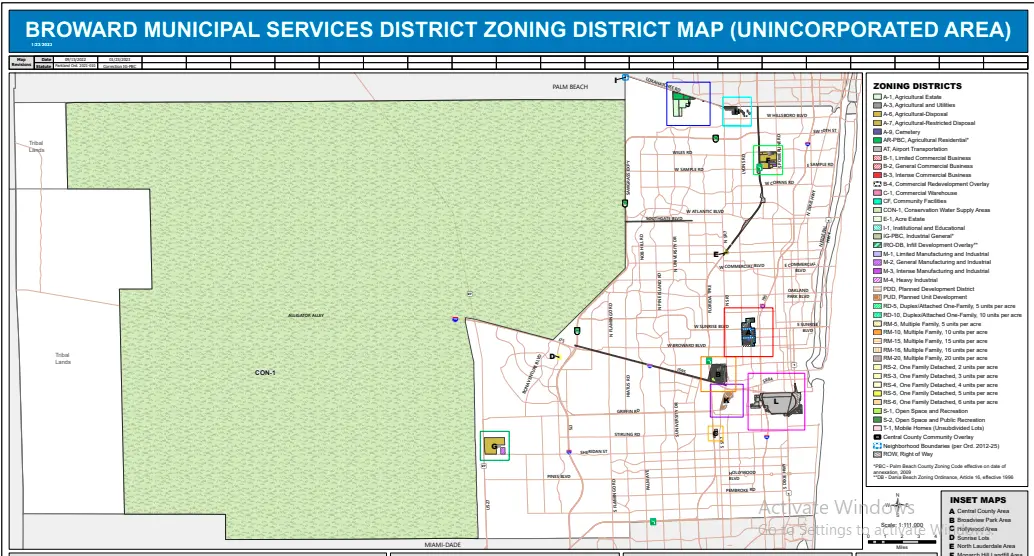
The single most important thing to understand about Broward County zoning is jurisdiction. Broward County Zoning administers Chapter 39 of the Broward County Code of Ordinances, but that code applies only to the Broward Municipal Services District (BMSD) — the unincorporated areas of the county. If your property sits inside one of Broward’s more than 30 incorporated municipalities, such as Fort Lauderdale, Hollywood, Pembroke Pines, Coral Springs, Davie, or Plantation, that city’s own zoning code governs your property instead, and you’d need to contact that municipality’s zoning administrator directly rather than the county office.
This distinction matters because zoning classifications, permitted uses, and even the names of zoning districts can differ from one city to the next, even for properties sitting right next to each other. When land gets annexed from unincorporated Broward into a city, it’s typically assigned a zoning classification equivalent to what it held under county zoning at the time of annexation — meaning the history of a parcel’s zoning can carry forward even after a jurisdictional change.
Major Land Use and Zoning Classification Categories
While specific district names vary by municipality, Broward County’s zoning framework — and most of its cities’ codes, which are broadly modeled on similar principles — organize land into a handful of core categories.
Residential Districts
These districts regulate housing density and type, ranging from low-density single-family zoning to higher-density multifamily districts. Specific classifications typically control lot size minimums, setbacks, height limits, and how many dwelling units are allowed per acre. A single-family district and a high-density apartment district might sit blocks apart but carry very different rules for what can be built.
Commercial Districts
Commercial zoning covers retail, office, and service-based uses, and is often broken into tiers — neighborhood-scale commercial (small retail, local services) versus general or regional commercial (larger shopping centers, bigger footprints, higher traffic generation). Planned commercial centers are also a recognized category under Broward’s code, allowing a coordinated commercial development to be reviewed and approved as a unified project rather than parcel by parcel.
Industrial Districts
Industrial zoning accommodates manufacturing, warehousing, distribution, and similar uses. Broward’s code recognizes planned industrial parks as a distinct classification, allowing industrial development to be planned and regulated as a cohesive district with shared infrastructure and access requirements rather than piecemeal industrial lots.
Agricultural Districts
Agricultural zoning protects land for farming and related uses and generally carries much lower allowed residential density than urban districts. Broward’s code also includes planned agricultural centers, a classification that allows agricultural-related commercial activity (like farm markets or agritourism uses) to be integrated into an agricultural zoning framework under specific conditions.
Transportation Districts
Broward’s zoning code includes a distinct category for transportation zoning districts, covering land used for airports, transit facilities, and similar infrastructure. These districts have their own permitted use lists, plot size and coverage rules, and height limitations tailored to transportation-related development rather than general commercial or residential use.

Community Facilities Districts
This classification covers land used for public and quasi-public purposes — schools, government buildings, religious institutions, hospitals, and similar community-serving uses — which typically don’t fit neatly into residential, commercial, or industrial categories but still require defined zoning standards.
Planned Residential Communities and Special Complexes
Beyond the standard categories, Broward’s code allows for planned residential communities and planned special complexes, which are large-scale developments reviewed holistically rather than as a collection of individually zoned parcels. This approach is common for master-planned neighborhoods or mixed-use developments that combine housing, retail, and open space under a single coordinated plan.
Mixed-Use Provisions
Broward’s zoning code explicitly allows for mixed uses under defined conditions, permitting a single development or district to combine residential, commercial, and sometimes light industrial elements. Mixed-use zoning has become increasingly common in redevelopment areas where walkability and reduced reliance on cars are development priorities.
Zoning Classification Categories at a Glance
| Category | Typical Uses Allowed | Key Consideration |
| Residential | Single-family homes, multifamily housing | Density, setbacks, and height vary significantly by district |
| Commercial | Retail, office, services | Often tiered by scale (neighborhood vs. general commercial) |
| Industrial | Manufacturing, warehousing, distribution | Planned industrial parks allow coordinated development |
| Agricultural | Farming, limited agricultural commercial use | Lower residential density; planned agricultural centers permitted |
| Transportation | Airports, transit facilities | Distinct permitted-use and height rules |
| Community Facilities | Schools, government, religious, medical | Standards tailored to public/institutional use |
| Planned Communities | Master-planned residential or mixed developments | Reviewed as a coordinated whole, not parcel by parcel |
| Mixed-Use | Combined residential, commercial, sometimes industrial | Common in redevelopment and walkable-design areas |
How to Find the Zoning of a Specific Property
For property in unincorporated Broward County (the BMSD), zoning verification and district information is handled by Broward County Zoning, which administers Chapter 39 of the county code. Property owners or developers with unincorporated parcels can request a meeting with the zoning office — typically scheduled Wednesdays and Thursdays — by emailing the property address or folio number along with contact details.
For property inside an incorporated city, you’ll need to go through that municipality’s zoning administrator or planning department instead, since the county code doesn’t govern city-zoned land. Most cities publish their own zoning maps online, and third-party zoning lookup tools can also help identify a starting point, though the municipality itself remains the authoritative source for confirming current zoning and permitted uses.
Overlay Districts and Special Zoning Tools
Beyond the base zoning categories, Broward County and its municipalities also use overlay districts and special zoning tools layered on top of standard classifications. These can include historic preservation overlays that add design review requirements on top of a property’s base zoning, transit-oriented development overlays that encourage denser, walkable development near transit corridors, and corridor or redevelopment overlays aimed at revitalizing specific commercial strips. A parcel can carry both a base zoning classification and one or more overlay designations at the same time, which means checking only the base zoning district can miss additional restrictions or opportunities that apply to that specific location.
Special exceptions and variances are another tool worth understanding. A special exception allows a use that isn’t automatically permitted in a zoning district but may be approved under specific conditions after a public hearing, while a variance allows relief from a dimensional standard — like a setback or height limit — when strict application of the code would create an unusual hardship. Neither changes the underlying zoning classification itself; both are case-by-case approvals layered on top of it.

The Rezoning Process
When a property’s current zoning doesn’t support a desired use, an owner can apply for rezoning — a formal request to change the zoning classification assigned to a parcel. In Broward County, rezoning applications typically go through a review process that includes staff analysis for consistency with the county’s comprehensive plan, public notice to surrounding property owners, and a public hearing before final action is taken. Because rezoning is a legislative decision rather than an administrative approval, it isn’t guaranteed even when a proposed use seems reasonable — neighboring property owners can raise objections, and the review body weighs compatibility with the surrounding area alongside the applicant’s request.
Rezoning is a materially different and typically longer process than a special exception or variance, since it permanently changes what the zoning code allows on a parcel rather than granting a specific, conditional approval. Anyone considering a use that clearly falls outside their property’s current classification should budget realistic time — often several months — for a rezoning request to move through review and hearing before construction or a change of use can begin.
Why Zoning Classification Matters Beyond “What Can I Build”
Zoning affects far more than new construction. It determines whether you can legally operate a home-based business, whether a property can be converted from residential to commercial use, how many units can occupy a multifamily lot, and what setback or height restrictions apply to an addition or accessory structure. It also directly affects a property’s value and marketability — a parcel zoned for higher-density development is often worth more to a developer than an identical lot zoned strictly single-family, even if the current structure on each is similar.
Zoning also intersects with the building permit process. In the Broward Municipal Services District, all new tenants or a change of occupancy for a commercial, retail, office, or industrial property must first obtain a Certificate confirming compliance with the Florida Building Code, the Broward County Zoning Code, and Fire Marshal requirements — meaning zoning compliance is checked before a business can even legally occupy a space, not just before construction begins.
Common Zoning Mistakes Property Owners Make
A few missteps come up repeatedly. Assuming county zoning rules apply to a property that’s actually inside a city (or vice versa) is one of the most common, since the two systems can have entirely different classification names and standards for what looks like the same type of district. Purchasing a property with the intention to convert its use — turning a residential structure into a short-term rental or commercial space, for example — without confirming the zoning permits that use first is another frequent and costly mistake. And relying solely on third-party zoning websites without verifying current status directly with the county or city can lead to outdated or inaccurate assumptions, since zoning maps and classifications are periodically amended.
Frequently Asked Questions
Does Broward County zoning apply to my property if I live in a city like Fort Lauderdale or Hollywood? No. Broward County’s Chapter 39 zoning code applies only to unincorporated areas (the Broward Municipal Services District). Properties inside incorporated cities are governed by that city’s own zoning code instead.
How do I find out what my property is zoned? For unincorporated Broward County parcels, contact Broward County Zoning directly with your property address or folio number. For property inside a city, contact that municipality’s zoning or planning department, since they maintain the authoritative zoning maps for their jurisdiction.
Can zoning classification change over time? Yes. Zoning maps and classifications can be amended through rezoning processes and comprehensive plan amendments, and land annexed from the county into a city may eventually be reassigned a city-specific zoning classification.
What’s the difference between zoning and land use? Zoning regulates the specific rules for a parcel — density, setbacks, permitted uses, height — while land use (often shown on a broader Future Land Use Map) reflects the general category of development a comprehensive plan envisions for an area. Zoning must generally be consistent with the underlying land use designation.
Do I need a zoning verification before buying commercial property? It’s strongly recommended. Confirming zoning and permitted uses before purchase avoids discovering after closing that your intended use — a restaurant, a specific type of retail, a change of occupancy — isn’t allowed under the property’s current zoning classification.
What is a planned development, and how is it different from standard zoning? A planned development, such as a planned residential community or planned commercial center, is reviewed as a coordinated whole rather than as individually zoned parcels, allowing a developer to combine multiple uses or a larger master plan under a single approval process instead of piecing together separate standard zoning districts.
Where can I find historical zoning maps for a Broward County property? Broward County Zoning maintains historic zoning ordinances and maps dating back to 1952, along with aerial photography from as early as 1933, available for review through the county’s zoning office.
Conclusion
Zoning in Broward County isn’t a single, uniform system — it’s a patchwork of county rules for unincorporated land and more than 30 separate municipal codes for everything else, and confirming the correct jurisdiction is the first step before anything else makes sense. Once you know whether you’re working with county or city zoning, the classification categories themselves — residential, commercial, industrial, agricultural, transportation, community facilities, planned developments, and mixed-use — determine what’s actually possible on a given parcel, from the size of an addition to whether a business can legally operate there at all.
Before buying, building, or converting the use of a Broward County property, verifying current zoning directly with the appropriate county or city office is worth the extra step. It’s a far cheaper check than discovering after the fact that your plans don’t match what the zoning classification actually allows.