Owning a home in Broward County, whether in Fort Lauderdale, Hollywood, Pembroke Pines, Coral Springs, or Plantation, comes with a property tax bill that can feel steep given how quickly home values have risen. One of the simplest and most effective ways to reduce that bill is a residence homestead exemption. It costs nothing to file, it can save a homeowner hundreds or even thousands of dollars a year, and yet a surprising number of new and even long time homeowners never get around to applying.
This guide walks through who qualifies for the Broward County homestead exemption, what it does to your tax bill, how to apply through the Broward County Property Appraiser (BCPA), and the deadlines you need to know so you don’t leave money on the table.
Broward County Homestead Exemption at a Glance
| Category | Details |
| Filing agency | Broward County Property Appraiser (BCPA) |
| Standard filing window | January 1 through March 1 |
| Eligibility date | Must own and occupy home as permanent residence on January 1 |
| Standard exemption amount | Up to $50,000 (first $25,000 applies to all taxes, second $25,000 applies to non school taxes only) |
| Assessment cap | Save Our Homes cap limits annual assessed value increase to 3% or the CPI change, whichever is lower |
| Late filing deadline | Mid to late September of the same tax year, statutory cutoff, no multi year grace period |
| BCPA office address | 115 South Andrews Avenue, Room 111, Fort Lauderdale, FL 33301 |
| BCPA phone | (954) 357 6830 |
| Reapplication required | No, exemption renews automatically unless your status changes |
| Portability available | Yes, Save Our Homes savings can transfer to a new Florida homestead within 3 tax years |
What a Homestead Exemption Actually Does
A homestead exemption doesn’t lower your home’s market value. Instead, it reduces the assessed and taxable value that your local taxing authorities, including the school district, county, and city, use to calculate your annual bill. If your home is assessed at $450,000 and you qualify for the full exemption, up to $50,000 of that value can be excluded from taxation, lowering what you actually owe each year.
The Up to $50,000 Homestead Exemption Explained
Florida’s standard homestead exemption applies in two tiers, and both matter because they don’t work the same way for every taxing authority. The first $25,000 applies to assessed value between $0 and $25,000, and it reduces taxable value across all taxing authorities, including the school district. A second $25,000 exemption applies to assessed value between $50,000 and $75,000, but it only reduces taxable value for non-school taxes such as the county, city, and most special districts. In practice, homes assessed at $75,000 or more receive the full combined benefit, while lower valued homes receive a partial benefit.
The Save Our Homes Assessment Cap
Beyond the dollar exemption, a homestead exemption triggers Florida’s Save Our Homes cap, which limits how much your home’s assessed value can increase each year to no more than 3%, or the Consumer Price Index change, whichever is lower, regardless of how much market value actually rises. In a county where values have appreciated as quickly as Broward County’s have in recent years, this cap can be just as valuable as the dollar exemption itself, protecting long term owners from having their taxable value climb at the same pace as the market.
Portability, a Florida Specific Feature
If you’ve built up Save Our Homes savings on a previous Florida homestead and buy a new primary residence, Florida law lets you transfer, or port, some or all of that accumulated savings to your new home, up to a set cap. Portability isn’t automatic, requires its own application, and generally must be claimed within three tax years of leaving your prior homestead. Ask BCPA about it when filing your new homestead exemption, since skipping this step can mean losing years of savings.
Who Is Eligible for the Broward County Homestead Exemption
General Eligibility Requirements
To qualify for the homestead exemption in Broward County, you need to meet a handful of requirements.
Ownership: you must hold legal or equitable title to the property, whether solely, jointly with a spouse or co owner, or as a qualifying trust beneficiary with the right to occupy the home.
Permanent residence: the home must be your primary residence, the place you actually live full time, not a rental, vacation home, or investment property. Florida law generally requires genuine intent to make the property your permanent home.
The January 1 rule: the single most important date in the process. You must own and occupy the home as your permanent residence on January 1 of the tax year you’re applying for. Close on or after January 2 and you generally won’t qualify until the following year.
Only one homestead: Florida law permits you to claim a homestead exemption on just one property at a time statewide. A prior exemption typically needs to be cancelled as part of filing for a new one.
Matching identification: your Florida driver’s license or state ID, plus vehicle and voter registration if applicable, should reflect the homestead address. BCPA also requires Social Security numbers for all owners and spouses, and non U.S. citizens must provide documentation of lawful immigration status.
Additional Exemptions for Specific Homeowners
On top of the general exemption, several categories of homeowners may qualify for additional relief.
Low income seniors age 65 and older whose prior year household income falls below a state set threshold, adjusted annually, may qualify for an additional exemption worth up to another $50,000 on county and other qualifying levies. This optional exemption must be applied for separately and re verified each year.
Disabled veterans have several paths to savings. Those with a VA service connected disability rating of 10% or more receive an additional exemption equal to their disability percentage multiplied by $5,000. Veterans totally and permanently disabled from a service connected cause can receive a full property tax exemption, and veterans 65 or older with a combat related disability may also qualify if they meet income requirements.
Non veterans who are totally and permanently disabled may qualify for additional amounts, typically subject to physician certification, and surviving spouses of veterans, first responders, and military members killed in the line of duty may qualify for a full exemption as well.
Additional exemptions generally must be applied for during the same January 1 through March 1 window as the general exemption, and several are re verified annually rather than applying automatically mid year.
How to Apply for the Broward County Homestead Exemption
Where to File
Homestead exemptions are filed with the Broward County Property Appraiser, commonly called BCPA, not the Tax Collector’s office. BCPA handles assessments and exemptions, while the Tax Collector only handles billing and collection after exemptions are already applied.
Step by Step Application Process
Get the application. BCPA offers Online Homestead Filing through its website, and paper forms, based on the state’s standard DR 501 form, are also available by download, mail, or in person.
Gather your documentation. At minimum you’ll want proof of ownership, a Florida driver’s license or state ID showing the homestead address, and Social Security numbers for all owners and spouses. Non U.S. citizens also need documentation of lawful immigration status.
Complete and sign the form. The application requires you to affirm the property was your permanent residence as of January 1, that you meet Florida’s qualifications, and that you aren’t claiming a homestead type exemption elsewhere. Filing a false application carries legal penalties.
Submit it to BCPA. Applications can be submitted online, by mail, or in person, at 115 South Andrews Avenue, Room 111, Fort Lauderdale, Florida 33301.
Confirm it was processed. Once approved, verify the exemption on your property record through BCPA’s website, or through the automatic renewal receipt card mailed in later years.
Do You Need to Reapply Every Year?
Once granted, you generally do not need to reapply every year. BCPA mails an automatic renewal receipt each January, and if nothing has changed, there’s nothing further to do. You must notify BCPA if your qualifications change, for example if you move, sell the property, or convert it to a rental, since failing to update your status can eventually result in back taxes, penalties, and interest.
Deadlines You Need to Know
Timing is where Broward County homeowners most often stumble, so it’s worth being precise about the key dates.
The Standard Filing Window
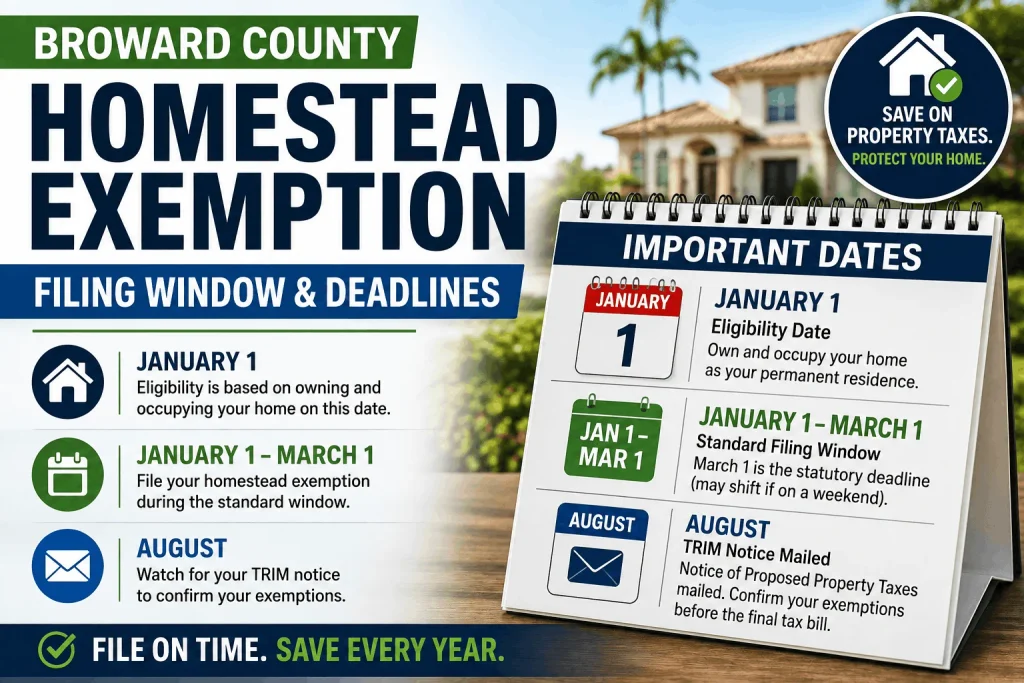
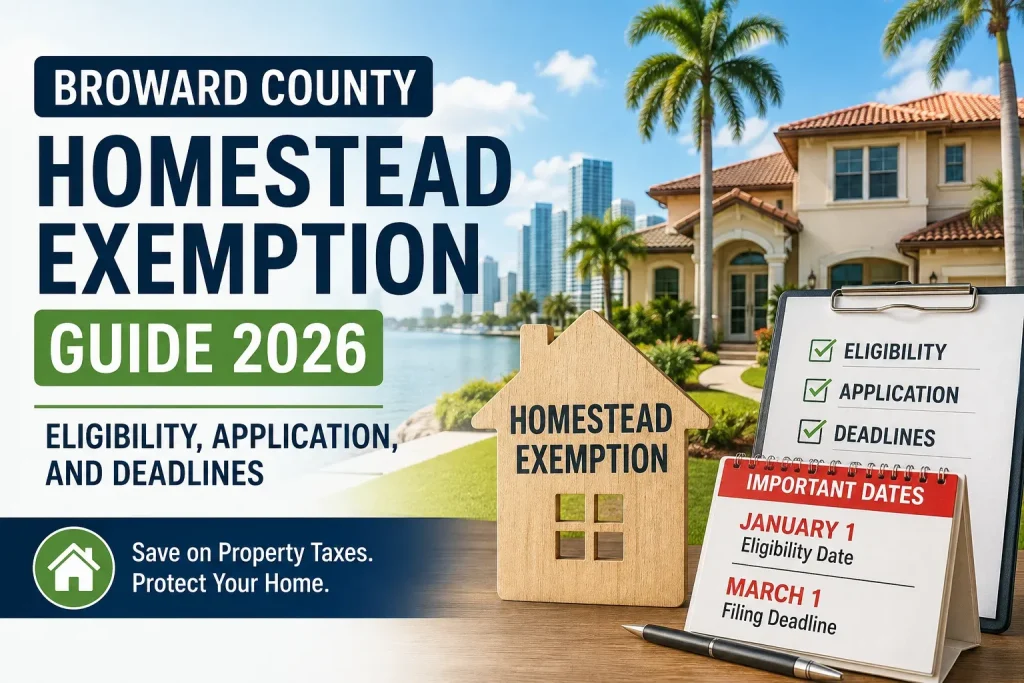
January 1 is the date that determines eligibility for the entire tax year. You must own and occupy the home as your permanent residence on this date to qualify.
January 1 through March 1 is the standard filing window, and March 1 is the statutory deadline, though the exact date can shift slightly if it falls on a weekend.
August is when Broward County mails the Notice of Proposed Property Taxes, commonly called the TRIM notice, your chance to confirm exemptions are correctly reflected before the final tax bill goes out.
The Late Filing Grace Period
Late filing works differently in Florida than in many other states, and the window is narrower than homeowners sometimes expect. If you miss March 1, Florida law under Section 196.011(8) of the Florida Statutes allows a late application for that same tax year, but only until a statutory cutoff that typically falls in mid to late September. Once that deadline passes, BCPA cannot accept any further applications for that year. Unlike states offering a multi year grace period, Florida’s window closes within the same calendar year it opened. If BCPA denies an application, you can petition the Value Adjustment Board, generally within 30 days of the denial notice.
Special Timing Situations
If you buy a home after January 1, you typically won’t qualify for the exemption on that property until the following tax year, since you didn’t own and occupy it on the relevant date. Plan accordingly if you’re closing in the spring, summer, or later.
If you believe you’ve missed a deadline, or aren’t sure whether a late application is still possible, contact BCPA directly. Details vary by circumstance, and staff can walk you through the options available.
Practical Tips for Broward County Homeowners
File as soon as you can after January 1, especially if you closed on your home during the prior year. There’s no advantage to waiting, and filing early avoids a last minute scramble as March 1 approaches.
Don’t confuse BCPA with the Tax Collector’s office. Exemptions are a Property Appraiser matter, while your bill and payment are handled separately by the Tax Collector.
Update your Florida driver’s license, voter registration, and vehicle registration soon after moving, since BCPA relies on these to confirm permanent residency.
Cancel any old exemptions promptly. If you previously claimed a homestead exemption elsewhere, notify that jurisdiction so it’s removed. BCPA cannot cancel it on your behalf if the former home is outside Broward County.
Ask about portability if it applies to you. If you’re moving from another Florida homestead, file the portability application alongside your new one so accumulated savings aren’t lost.
Conclusion
The homestead exemption is one of the most valuable, and most underused, tools available to Broward County homeowners. It’s free to apply for, the paperwork is straightforward, and the combination of the up to $50,000 exemption plus the Save Our Homes cap can add up to substantial savings over the years you own your home. If you owned and lived in your home as of January 1 and haven’t filed, submit your application to BCPA before March 1. If you’ve missed the deadline, contact BCPA promptly, since Florida’s late filing window closes earlier than homeowners from other states might expect.
Frequently Asked Questions
What is a homestead exemption, and how does it lower my taxes? It reduces the taxable and assessed value of your home, not its market value, for the taxing authorities that bill you. Florida’s standard exemption can reduce assessed value by up to $50,000, with the first $25,000 applying to all property taxes and the second $25,000 applying only to non-school taxes.
Who is eligible for the homestead exemption in Broward County? You must own the home, occupy it as your permanent residence, and have owned and lived in it as of January 1. You can only claim a homestead type exemption on one property at a time.
Does the closing date on my home purchase affect my eligibility? Yes. Closing on or after January 2 generally means you won’t qualify until the following tax year, since you didn’t own and occupy the home on the required date.
When is the deadline to file? The standard filing window is January 1 through March 1 of the tax year.
What happens if I miss the March 1 deadline? You’re not automatically out of luck, but the window is shorter than in some other states. Florida law allows a late application for that same tax year, up to a statutory cutoff in mid to late September, after which no further applications can be accepted.
Where do I submit my homestead exemption application? Applications go to BCPA, not the Tax Collector’s office. BCPA handles assessments and exemptions; the Tax Collector’s office only handles billing and collection.
Do I need to reapply for my homestead exemption every year? No. Once granted, the exemption renews automatically each year unless your qualifications change or BCPA requests verification.
Are there additional exemptions for seniors, disabled homeowners, or veterans? Yes. Low income homeowners 65 or older, permanently disabled homeowners, and disabled veterans may qualify for additional amounts on top of the standard exemption. Veterans totally and permanently disabled from a service connected cause can receive a full property tax exemption.
What is Save Our Homes portability, and does Broward County offer it? Yes. If you’re moving from a previous Florida homestead, you may transfer some or all of your accumulated savings to your new homestead, up to a set cap, generally within three tax years. This requires a separate portability application filed alongside your homestead exemption.
What documents do I need to apply for? At minimum, proof of ownership, a Florida driver’s license or state ID showing the homestead address, and Social Security numbers for all owners and spouses. Non U.S. citizens also need documentation of lawful immigration status.